Person · found on 2,269 slides
God
Also known as: LORD, Lord God, Elohim, YHVH, YHWH, Adonai, Hashem, Almighty, El Shaddai
Often studied together with: creationheavenetIsraelElohimwaterMosesbara
Abel 80 slides
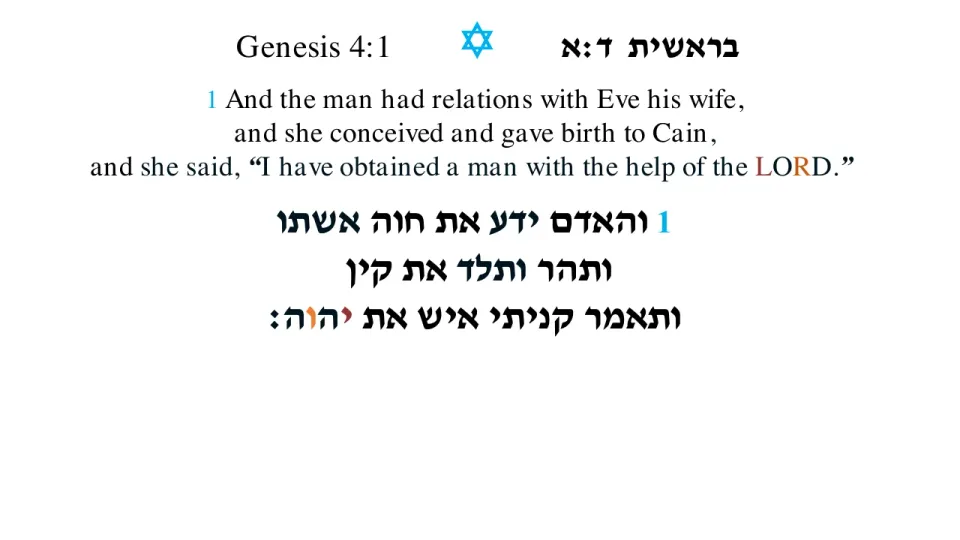 Genesis 4:1 — Eve gives birth to CainSlide 2
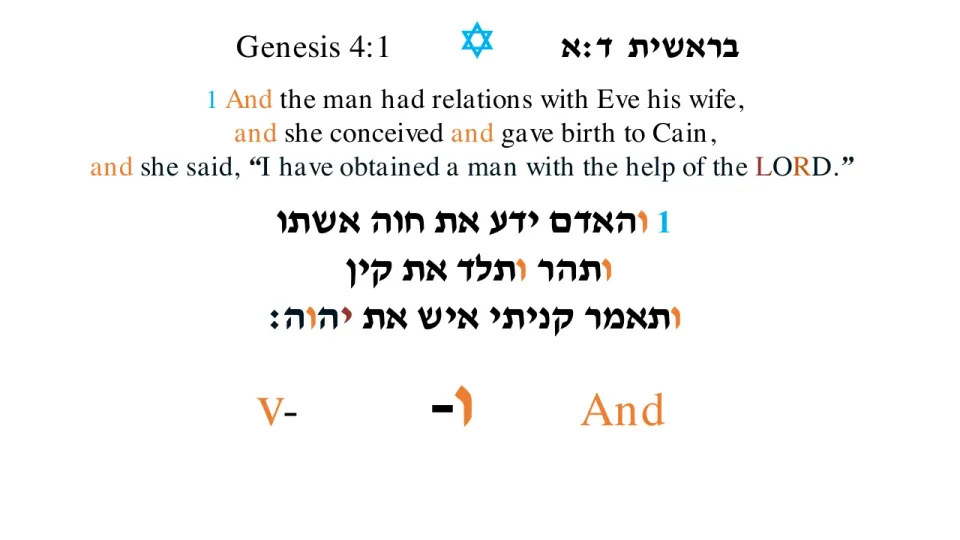 Genesis 4:1 — the Hebrew prefix vav (ו) means “and”Slide 3
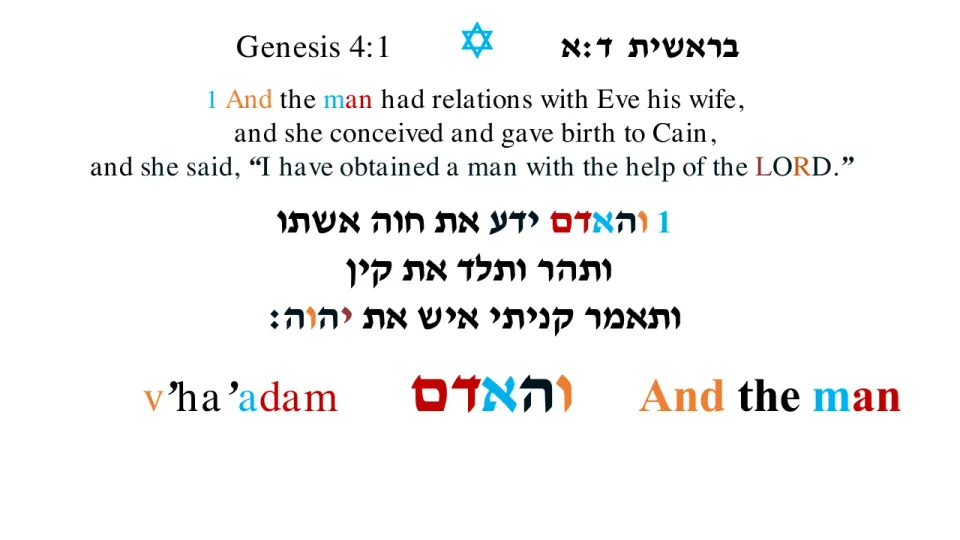 Genesis 4:1 — v'ha'adam, “and the man”Slide 4
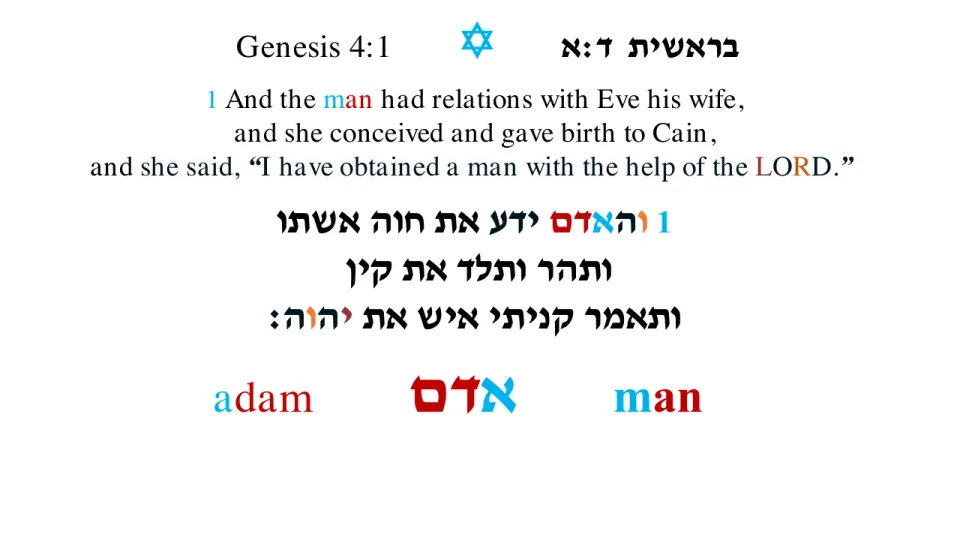 Genesis 4:1 — adam (אדם), “man”Slide 5
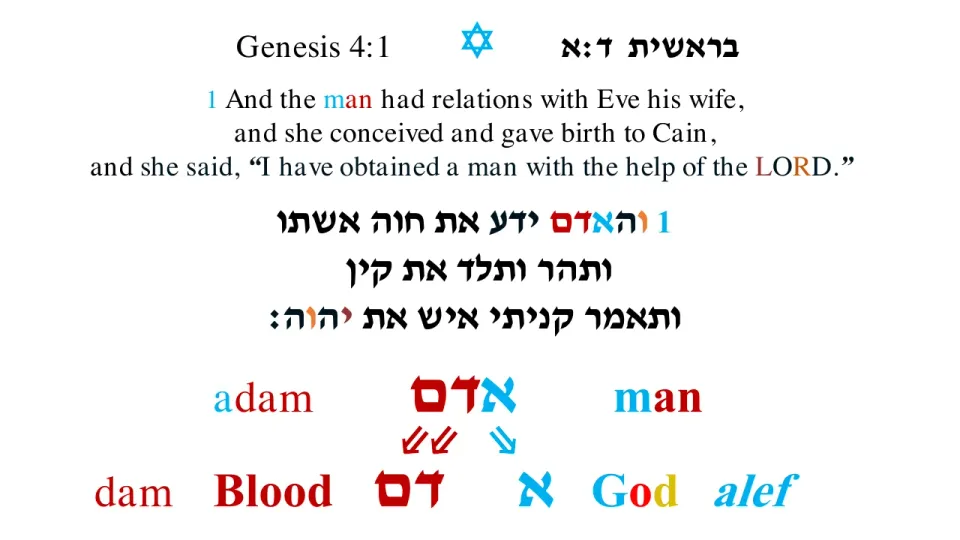 Adam (אדם) = alef (God) + dam (blood)Slide 6
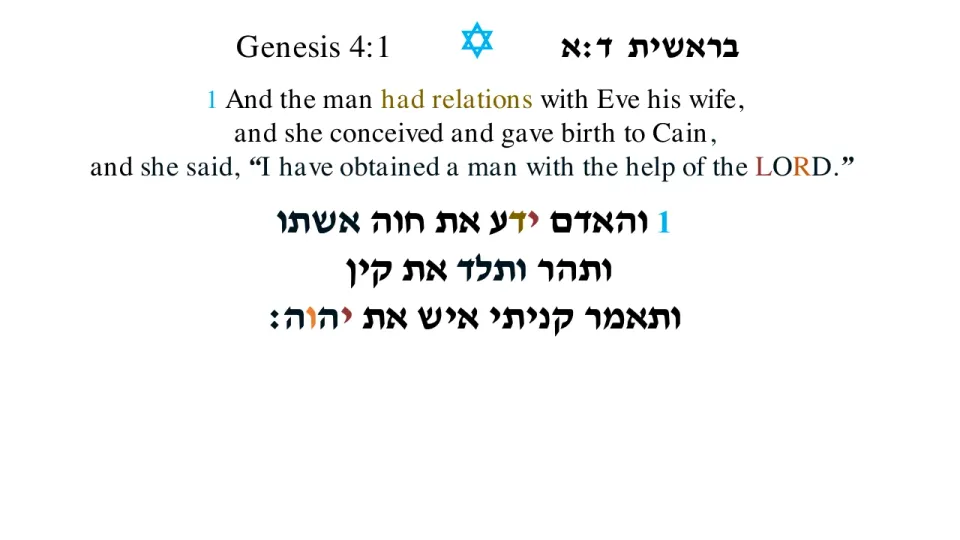 Genesis 4:1 — “had relations” is the Hebrew word ידעSlide 7
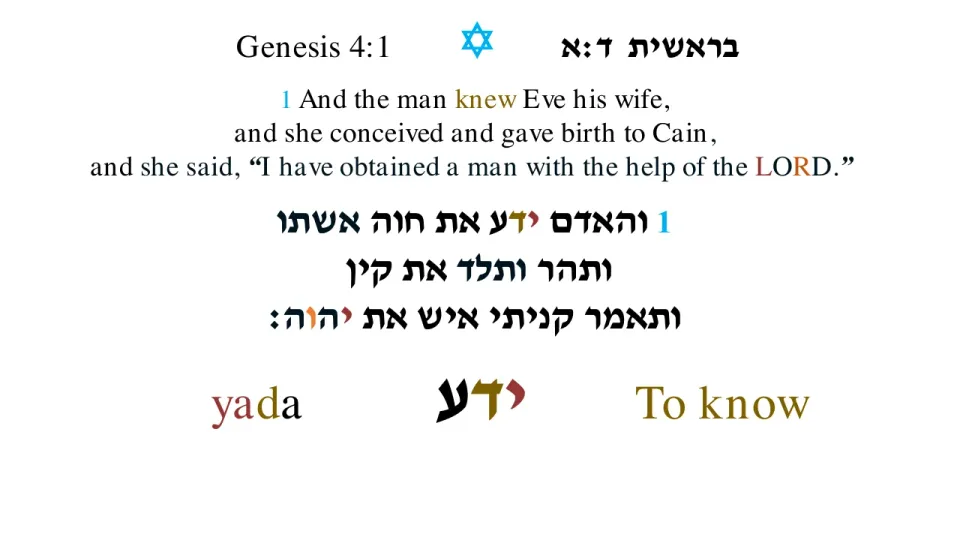 Genesis 4:1 — yada (ידע), “to know”Slide 8
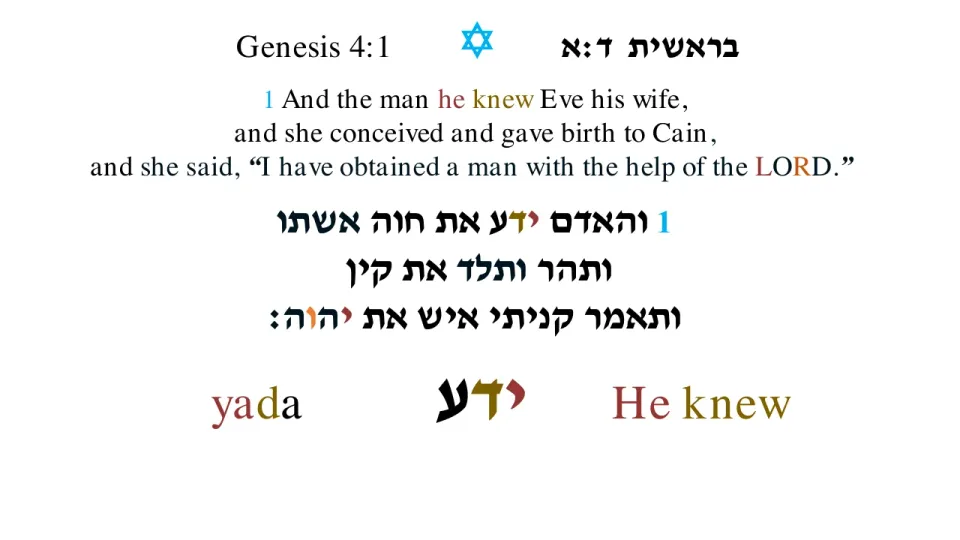 Genesis 4:1 — yada (ידע), “he knew”Slide 9
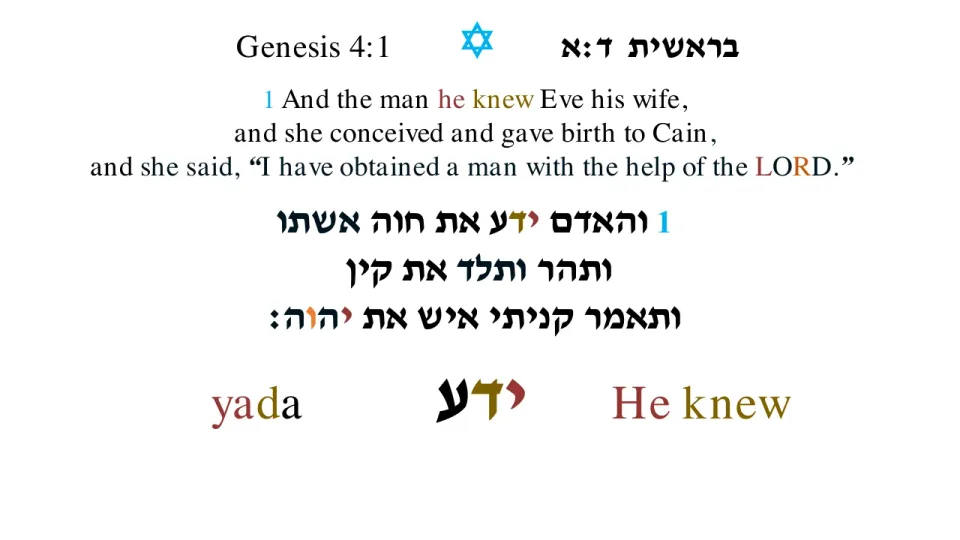 Genesis 4:1 — yada (ידע), “he knew” (repeat)Slide 10
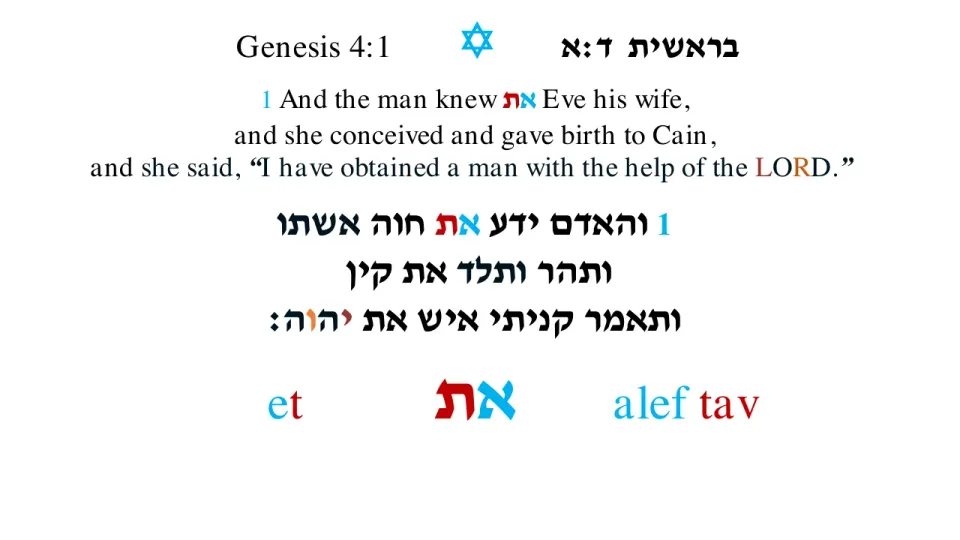 Genesis 4:1 — the untranslated word et (את), alef-tavSlide 11
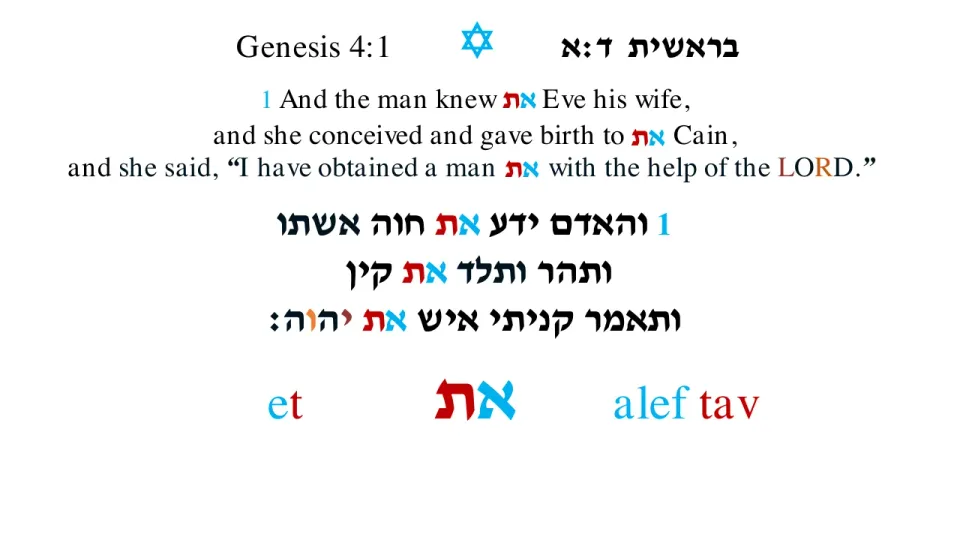 Genesis 4:1 — alef-tav (את) appears three timesSlide 12
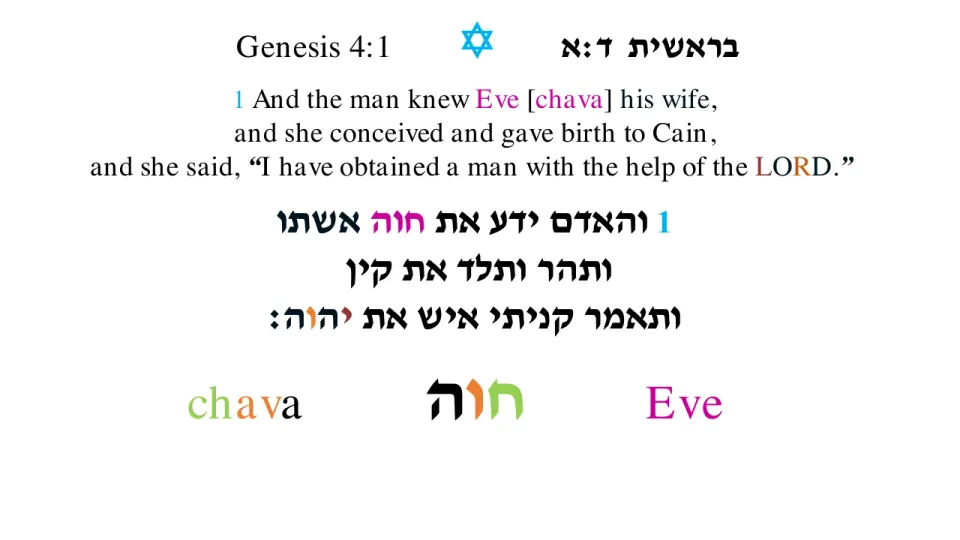 Genesis 4:1 — Eve is chava (חוה) in HebrewSlide 13
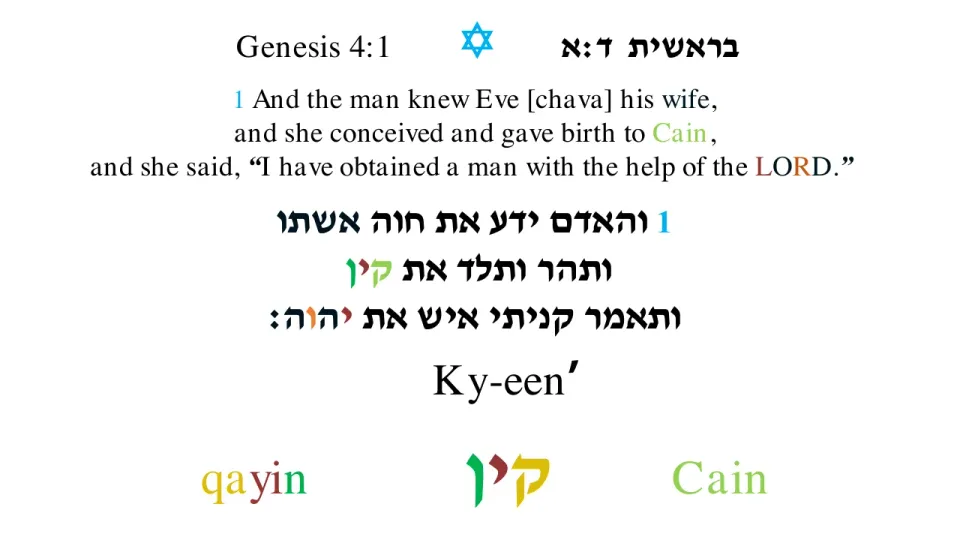 Genesis 4:1 — Cain is qayin (קין), pronounced “Ky-een”Slide 14
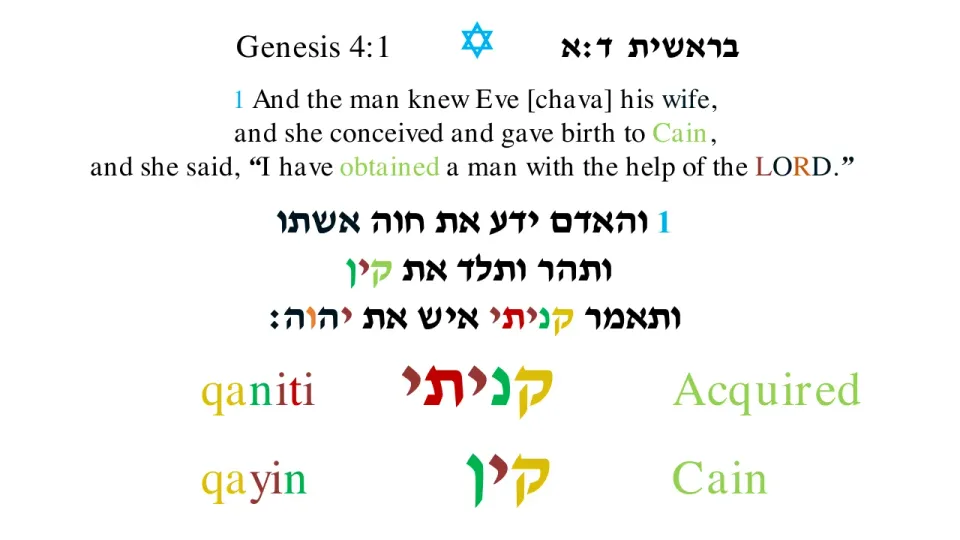 Genesis 4:1 — qaniti (קניתי) “acquired” and qayin (Cain)Slide 15
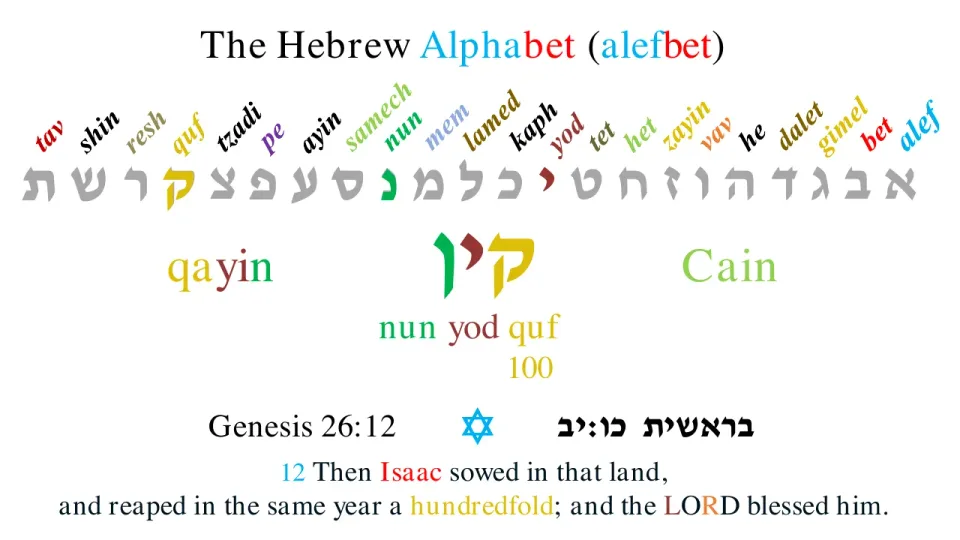 Cain (קין): quf = 100, with Genesis 26:12 (Isaac reaps a hundredfold)Slide 21
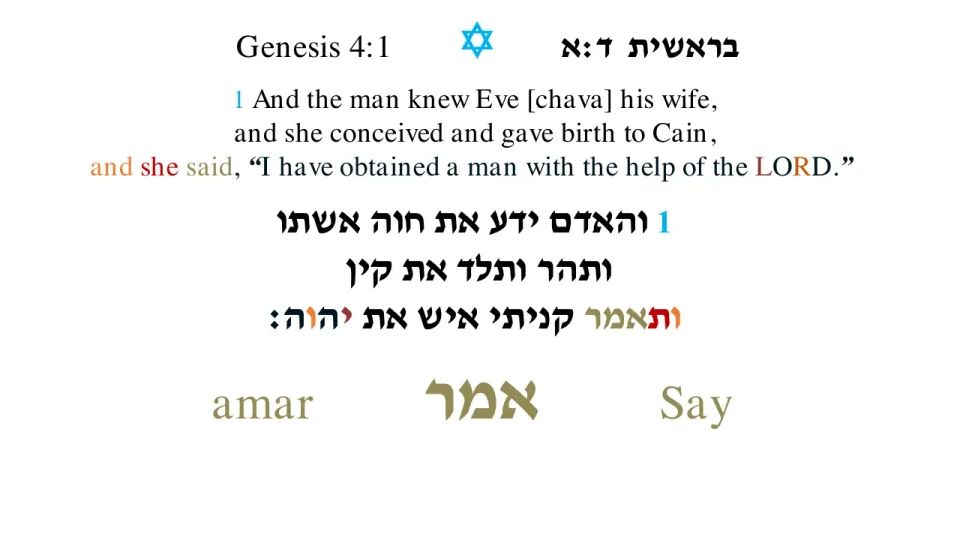 Genesis 4:1 — Eve says: “I have obtained a man”; amar = saySlide 24
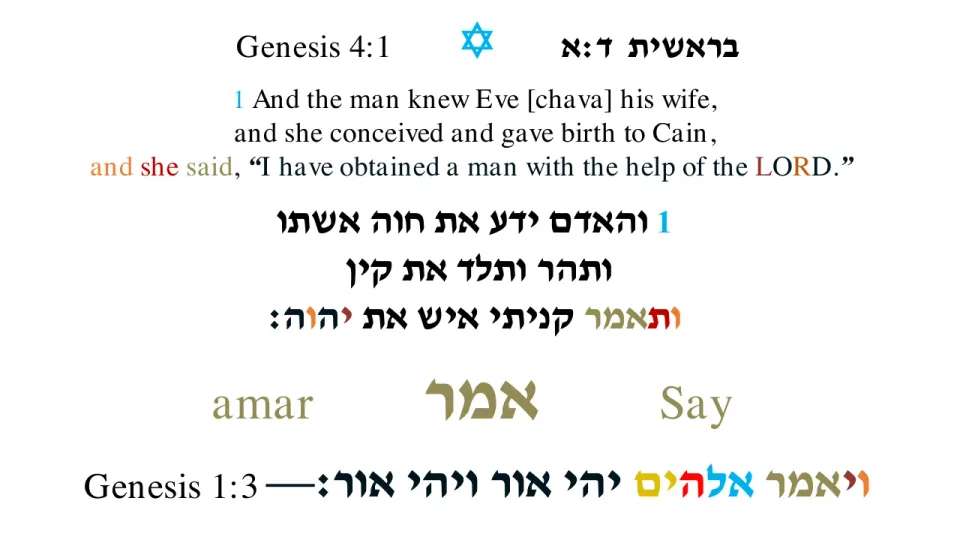 Genesis 4:1 and Genesis 1:3 — amar (say) in “and God said”Slide 25
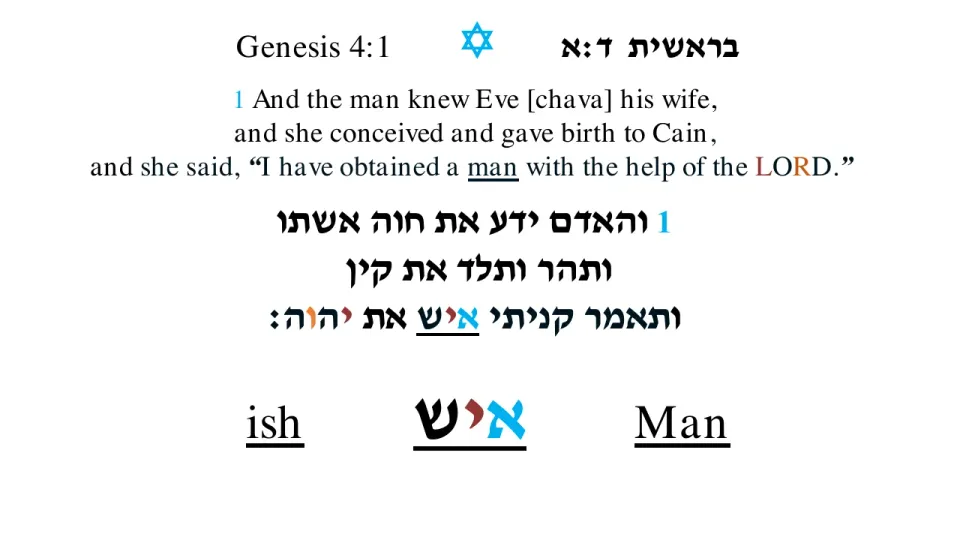 Genesis 4:1 — ish (איש) = manSlide 26
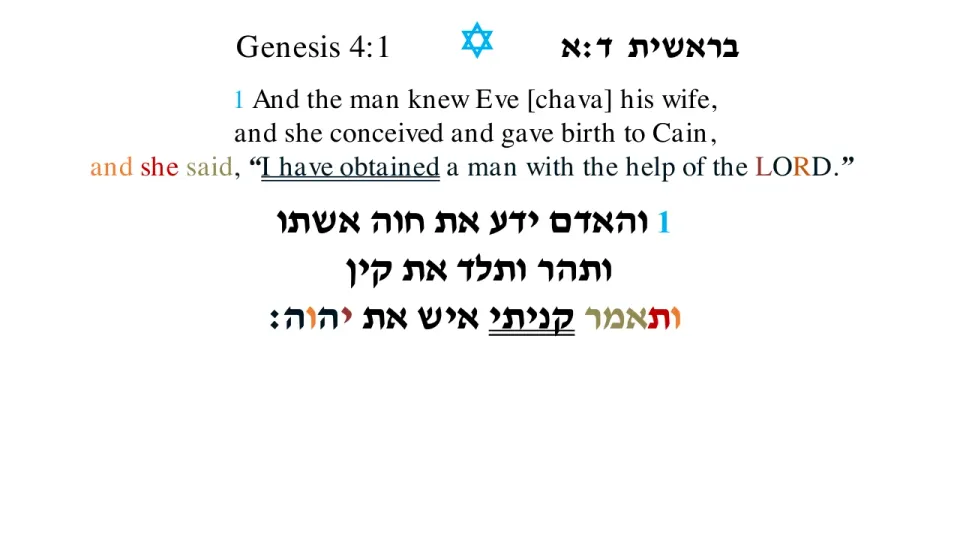 Genesis 4:1 — “I have obtained” = קניתי (qaniti)Slide 29
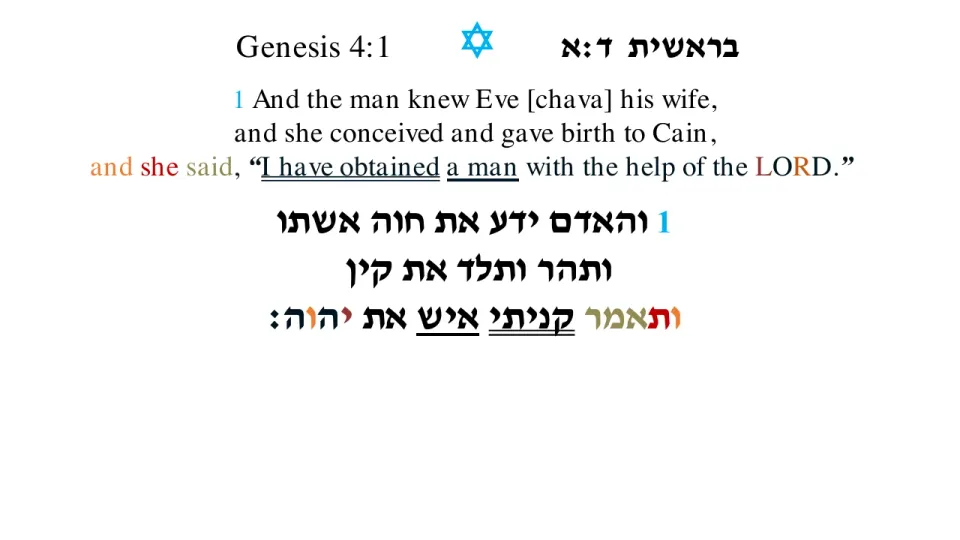 Genesis 4:1 — “a man” = איש (ish)Slide 30
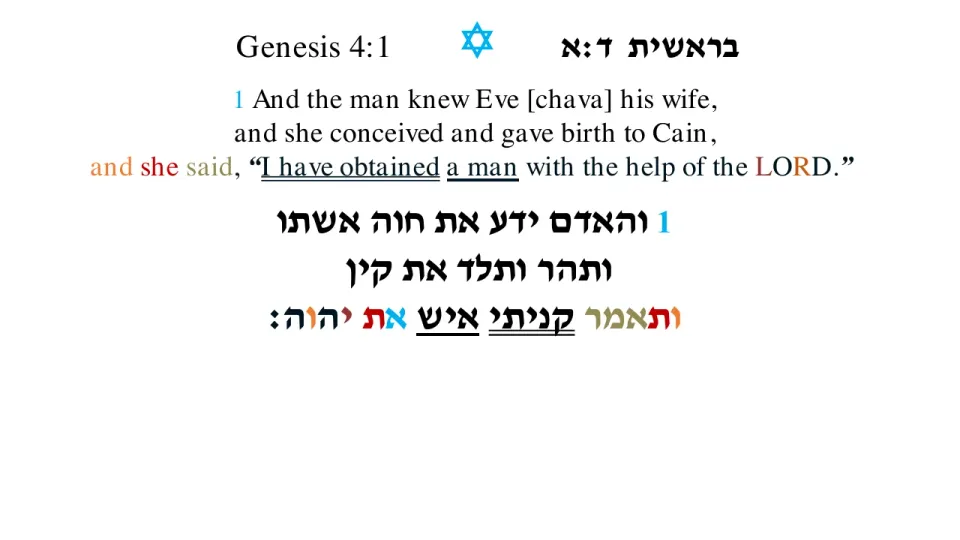 Genesis 4:1 — the untranslated word את (alef tav) before the LORDSlide 31
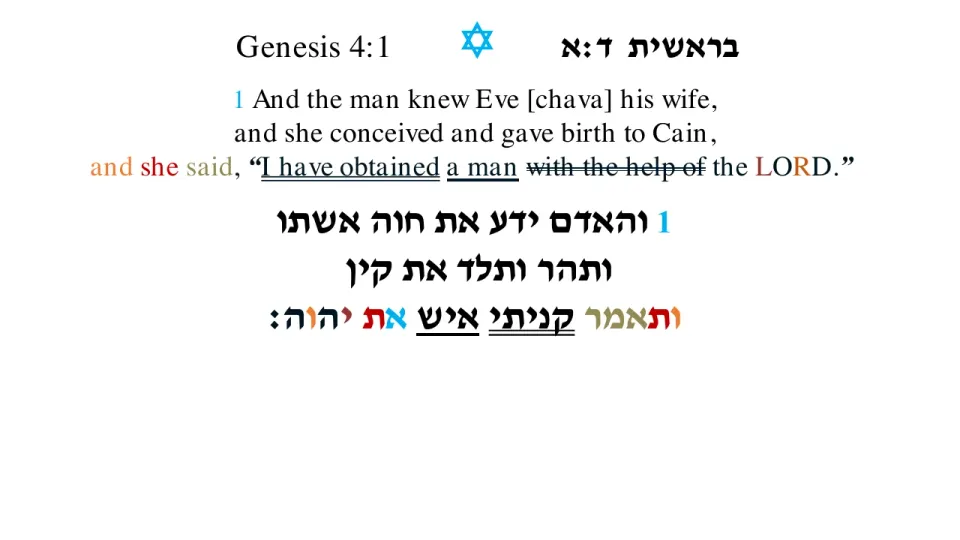 Genesis 4:1 — “with the help of” struck out; את stands before the LORDSlide 32
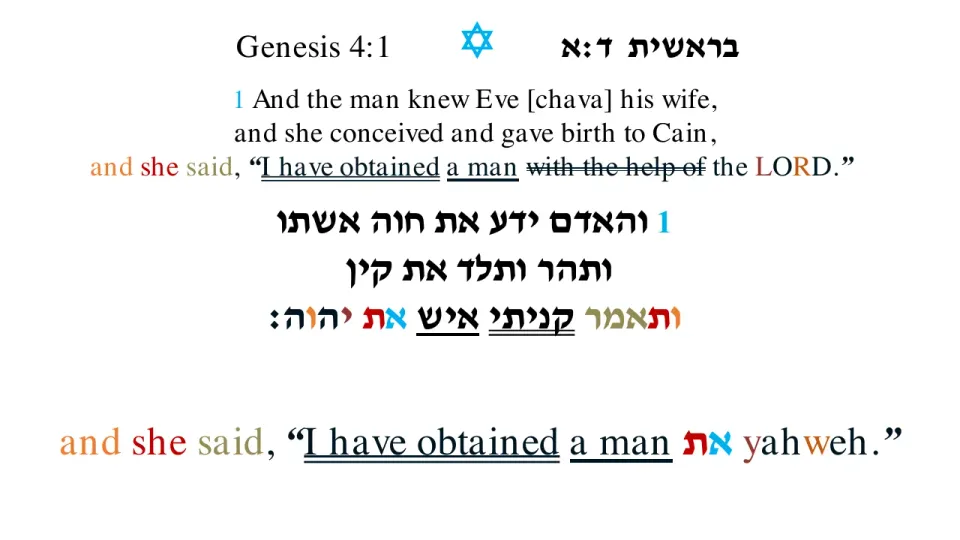 Genesis 4:1 — “I have obtained a man את yahweh”Slide 33
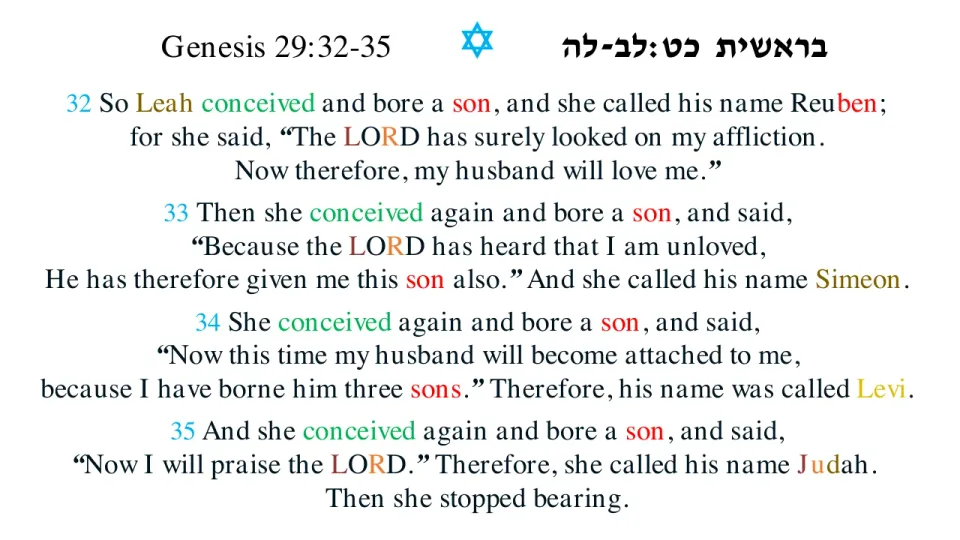 Genesis 29:32-35 — Leah conceives and bears Reuben, Simeon, Levi, JudahSlide 41
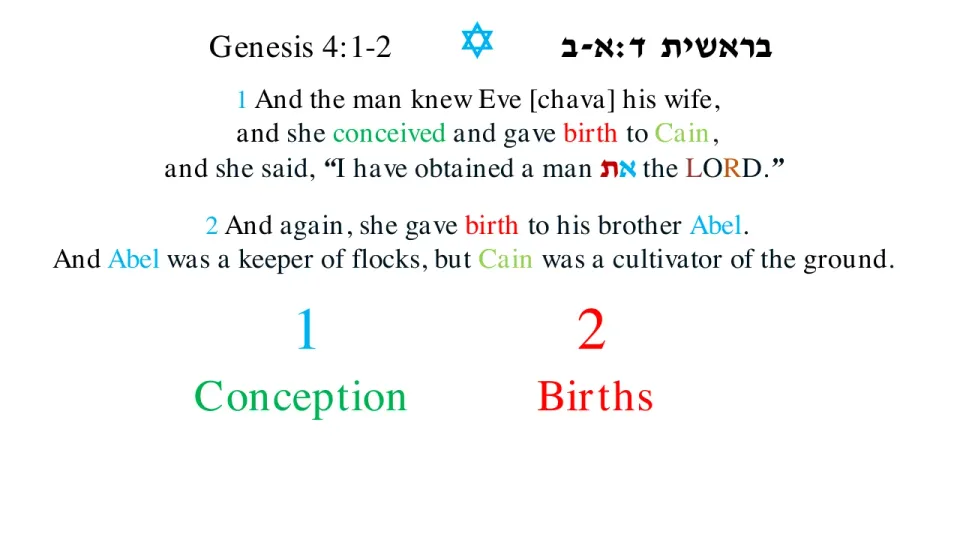 Genesis 4:1-2: 1 conception, 2 births (Cain and Abel)Slide 43
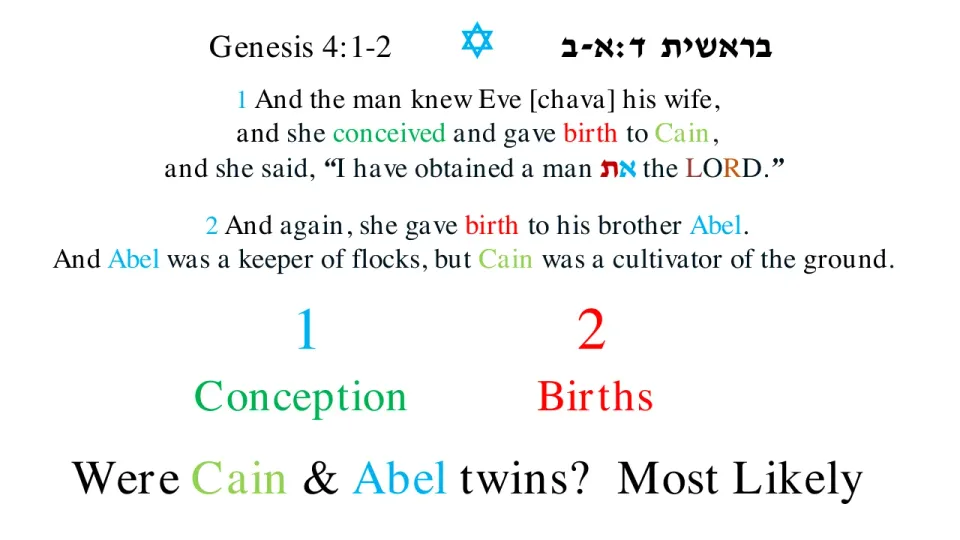 Genesis 4:1-2 — Were Cain and Abel twins? Most likelySlide 44
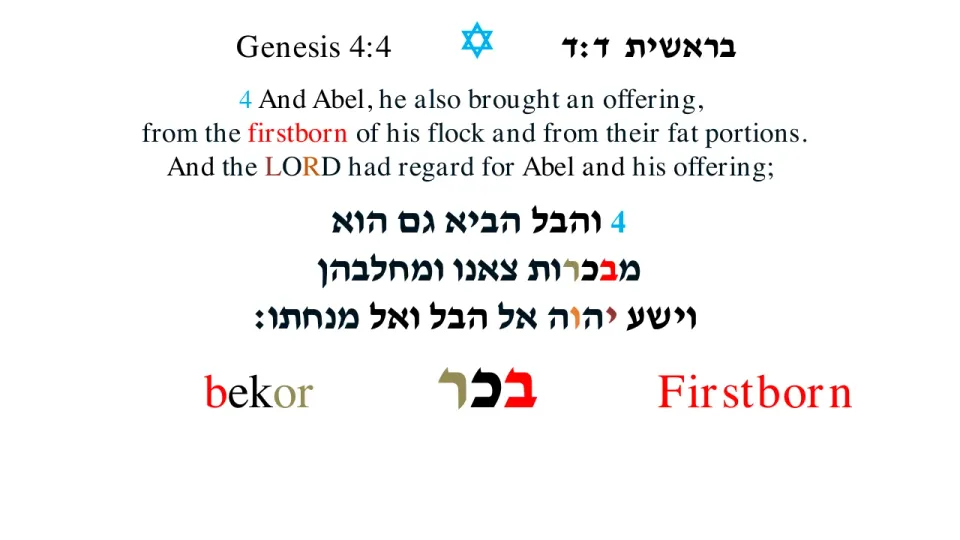 Genesis 4:4 — Abel brought the firstborn (bekor, בכר) of his flockSlide 56
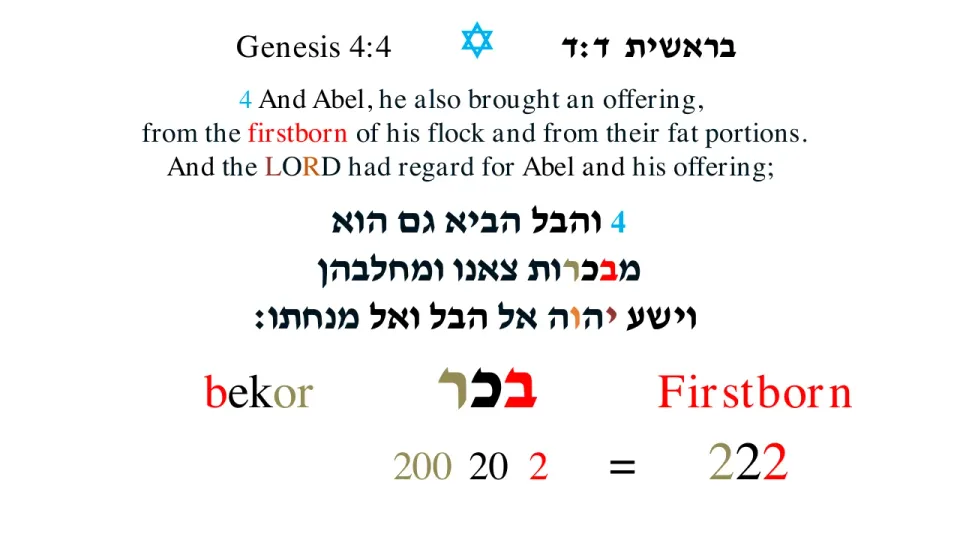 Genesis 4:4 — bekor (בכר, firstborn) has gematria 222Slide 57
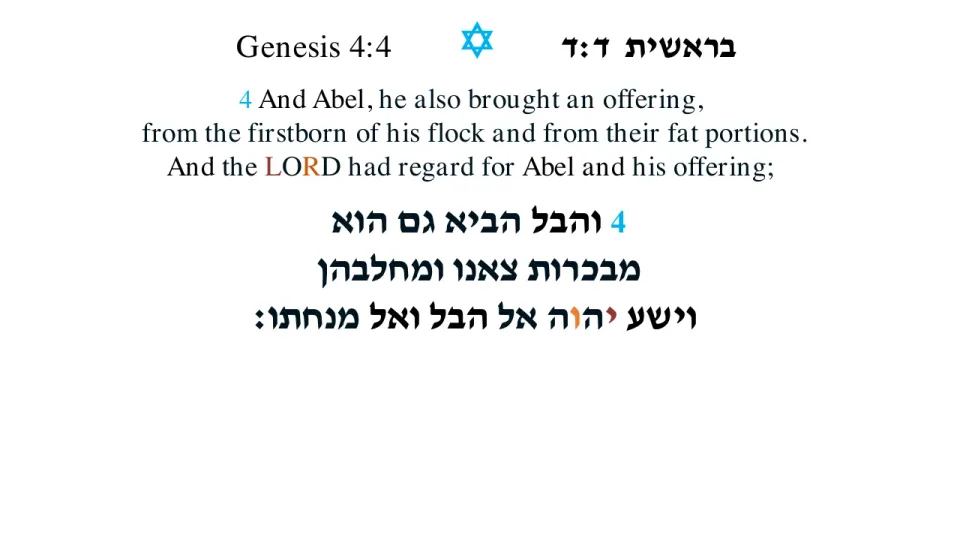 Genesis 4:4 — Abel brings the firstborn of his flock; the LORD has regard for AbelSlide 59
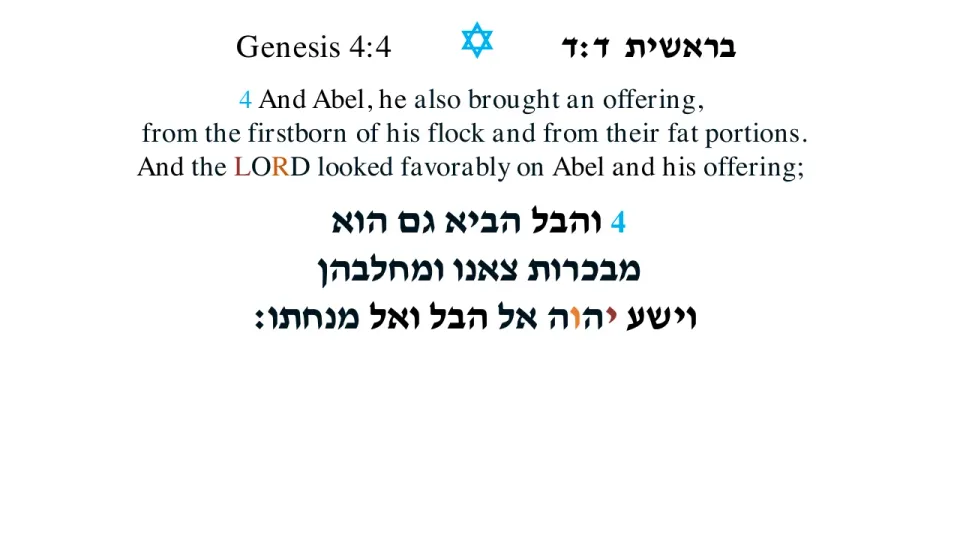 Genesis 4:4 — Abel brings the firstborn of his flock; the LORD has regard for AbelSlide 60
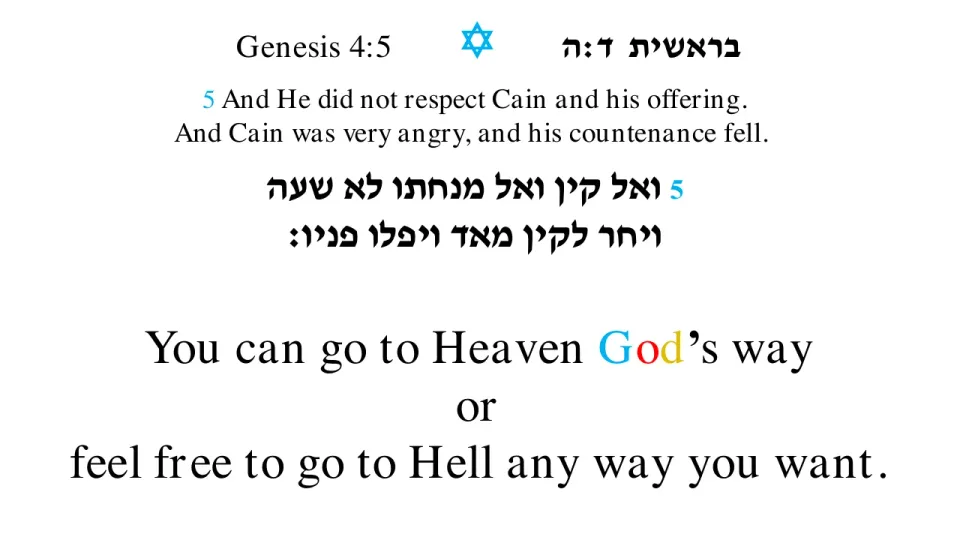 Genesis 4:5 — God did not respect Cain's offering; Heaven God's way or Hell your waySlide 61
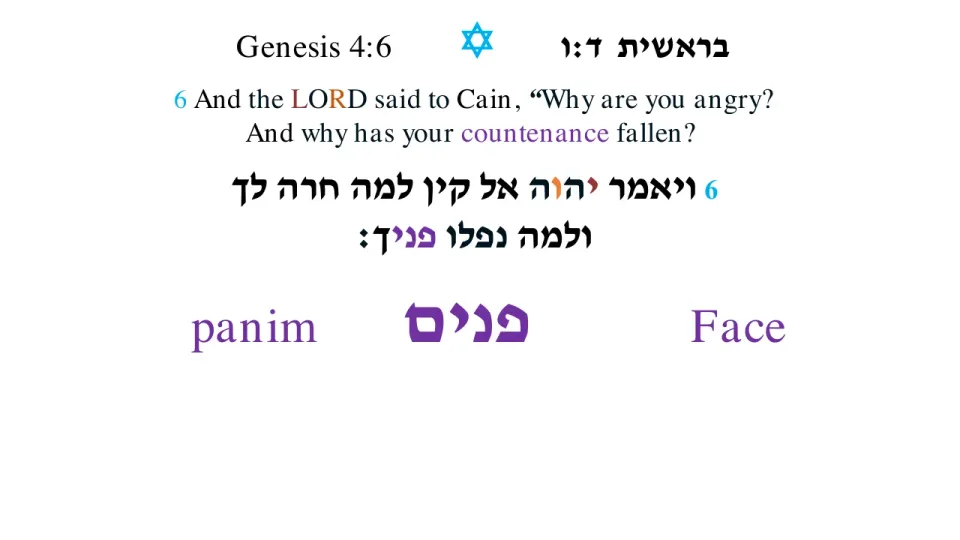 Genesis 4:6 — the LORD asks Cain why his face has fallen (panim)Slide 64
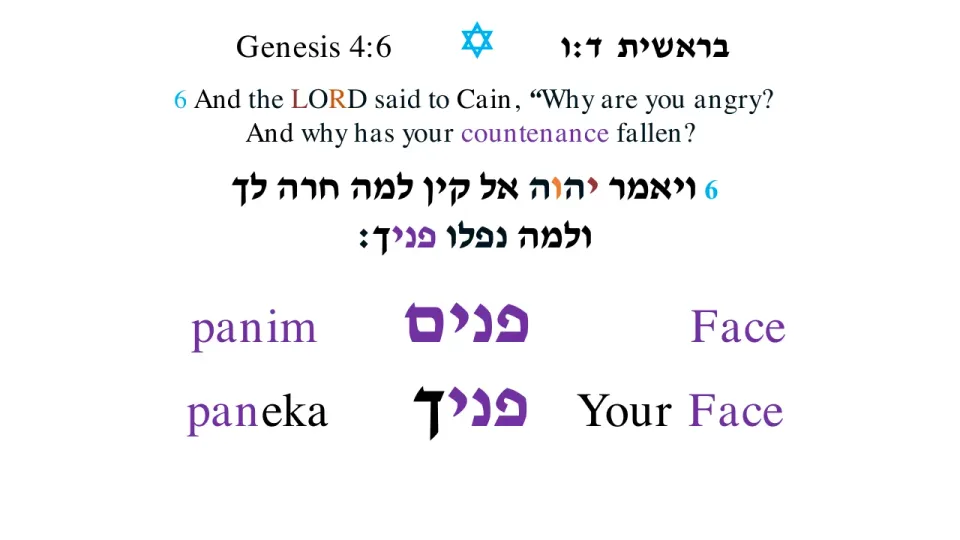 Genesis 4:6 — panim (face) becomes paneka (your face)Slide 65
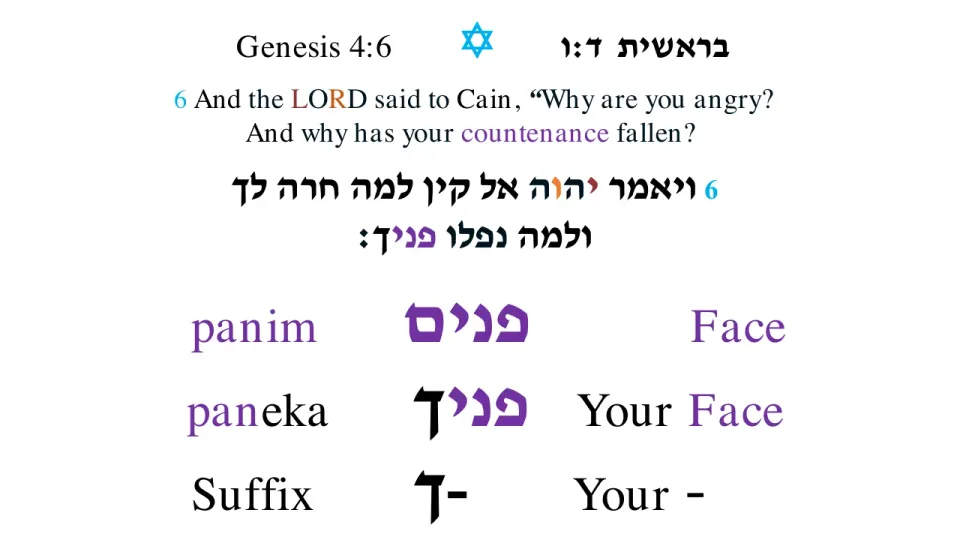 Genesis 4:6 — the suffix ך (-ka) means “your”Slide 66
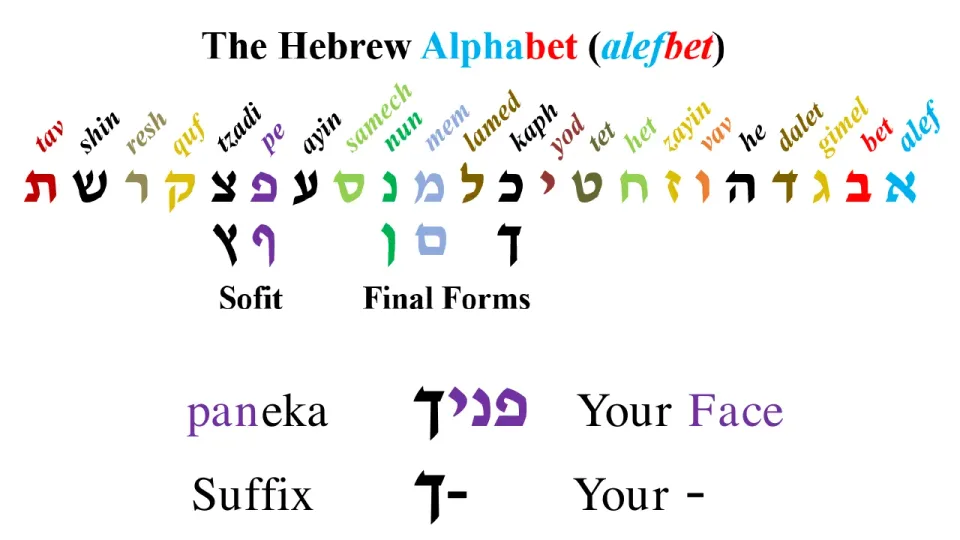 The Hebrew alphabet (alefbet) with final forms; paneka and the suffix ךSlide 67
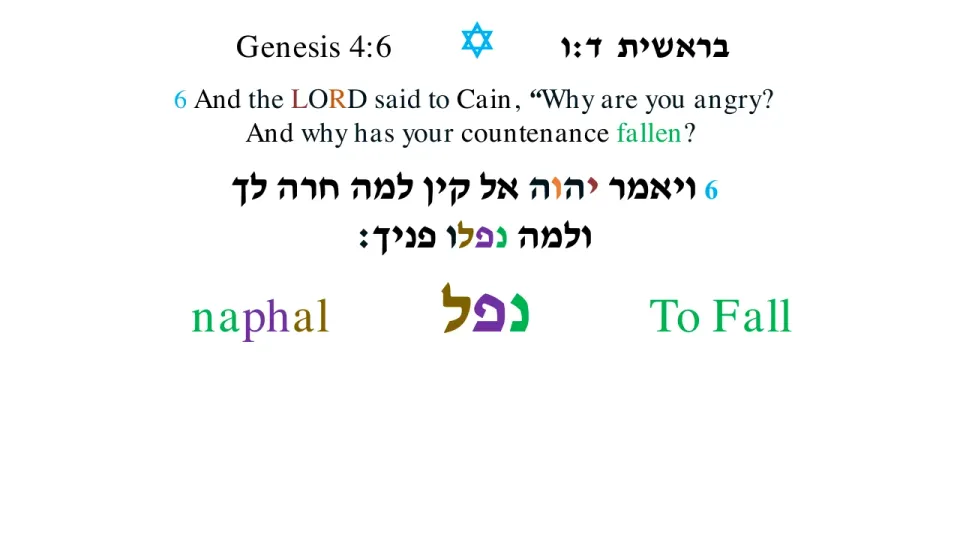 Genesis 4:6 — naphal (to fall)Slide 68
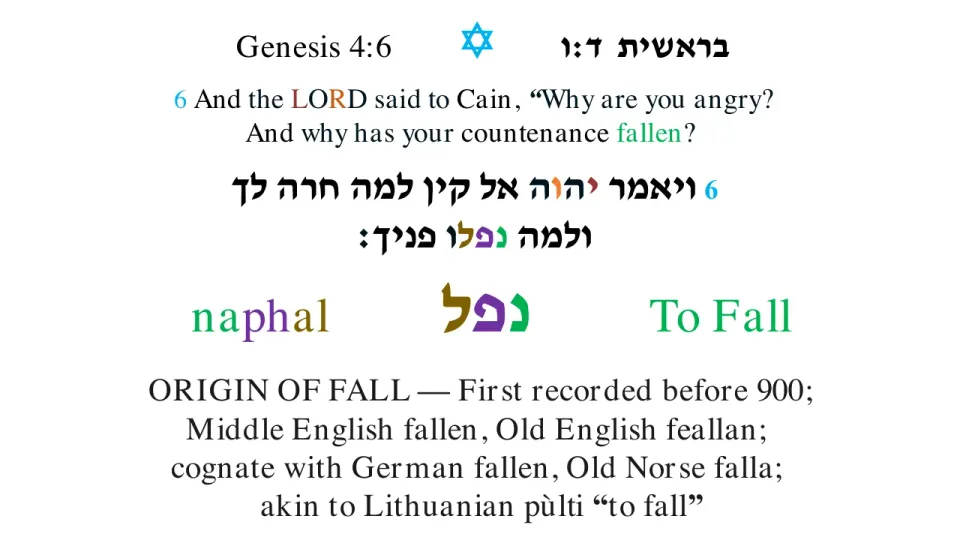 Genesis 4:6 — naphal (to fall) and the English origin of “fall”Slide 69
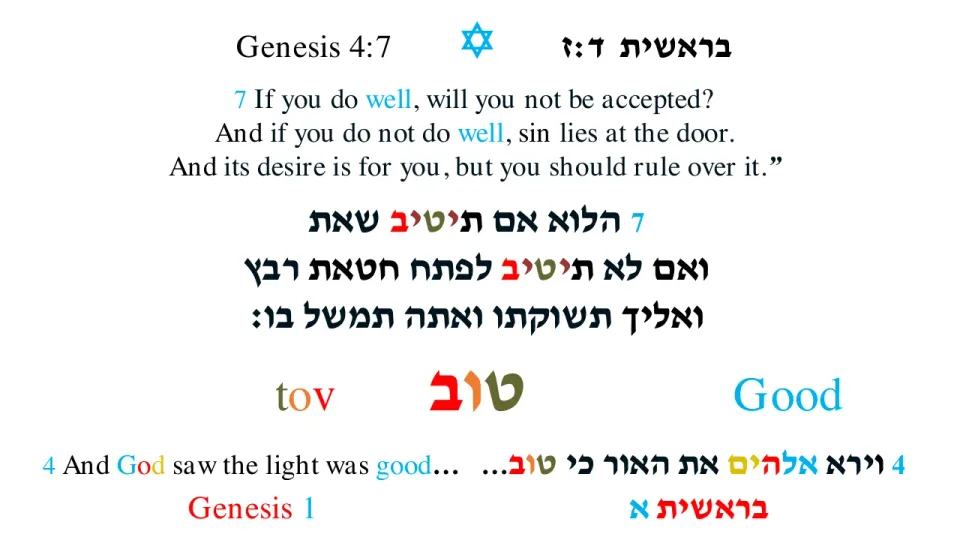 Genesis 4:7 — tov (good), compared with Genesis 1:4 “God saw the light was good”Slide 72
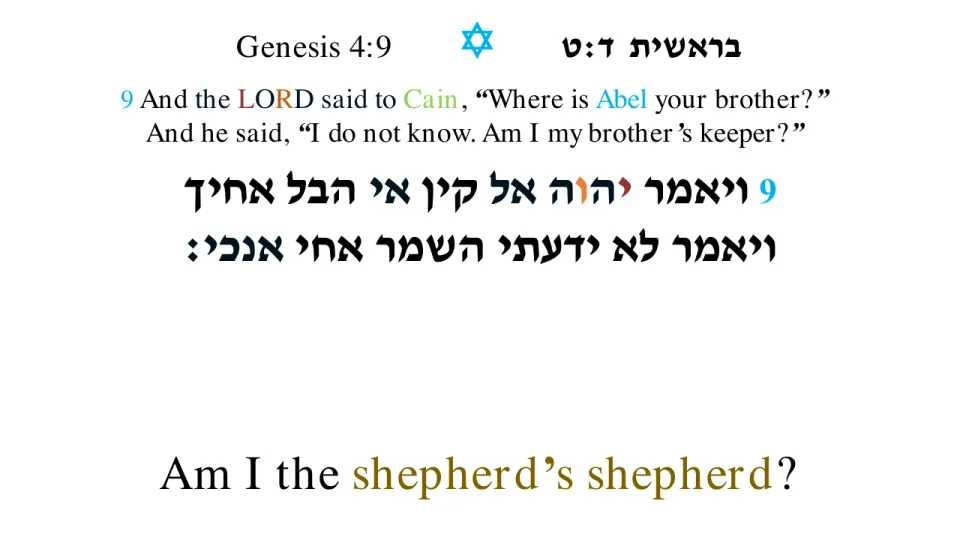 Genesis 4:9 — “Am I my brother’s keeper?” = Am I the shepherd’s shepherd?Slide 83
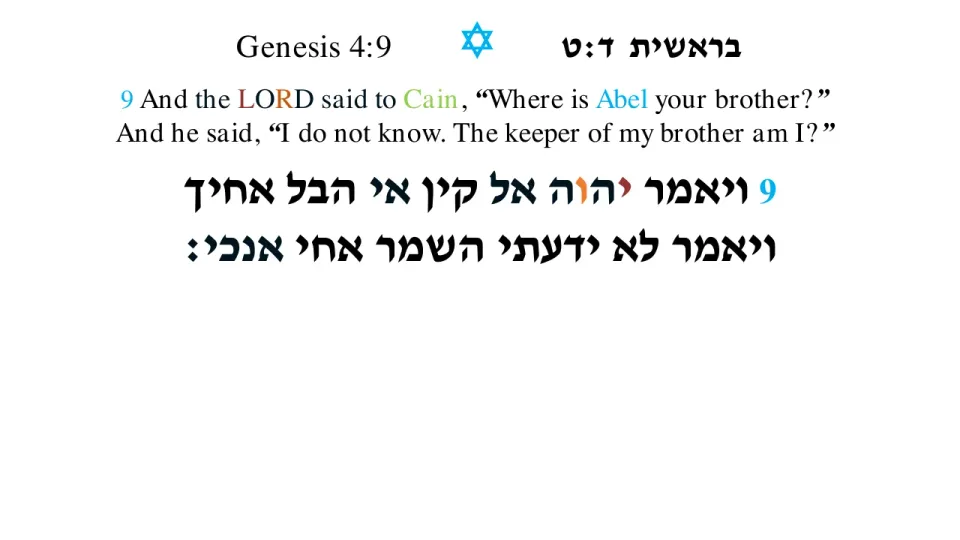 Genesis 4:9 — “The keeper of my brother am I?”Slide 84
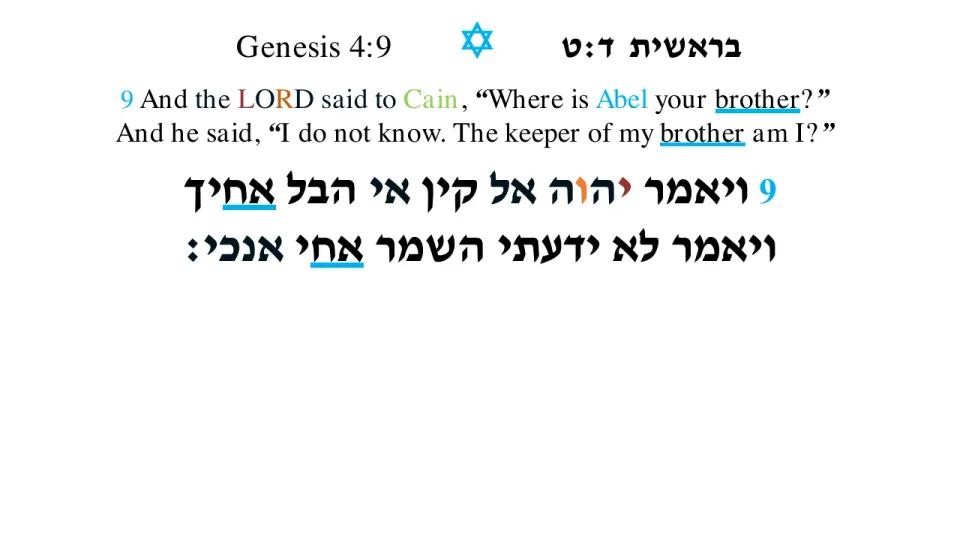 Genesis 4:9 — “brother” underlined twice (אחיך, אחי)Slide 85
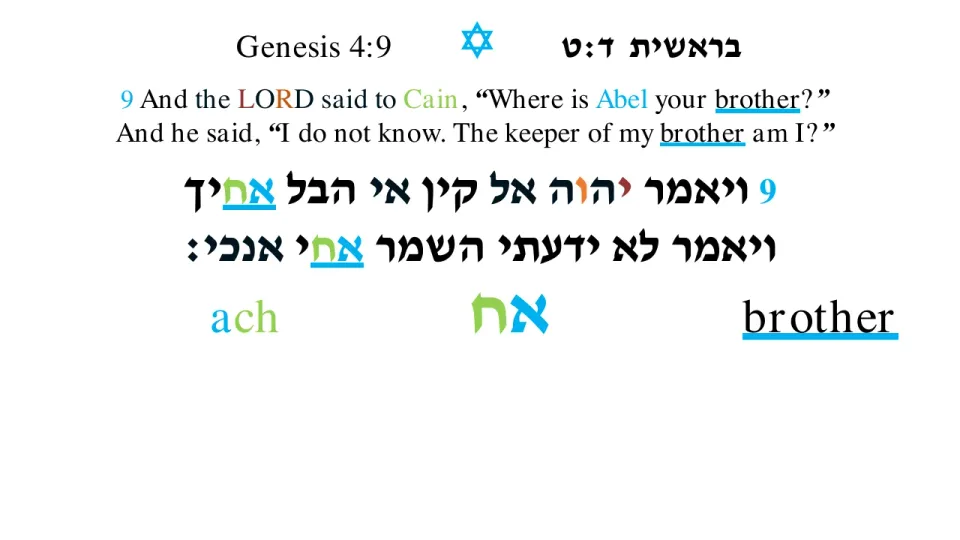 Genesis 4:9 — brother (ach, אח)Slide 86
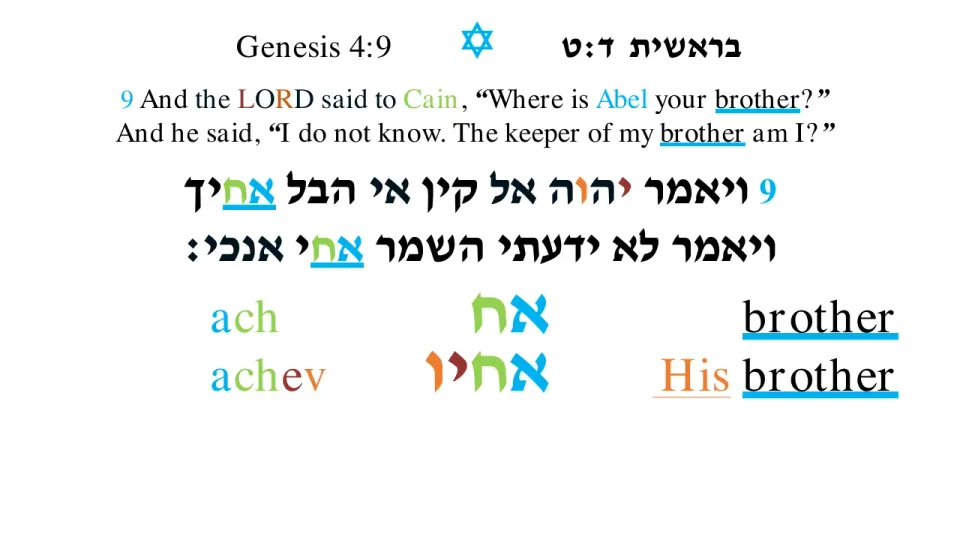 Genesis 4:9 — brother (ach, אח) and “his brother” (achev, אחיו)Slide 87
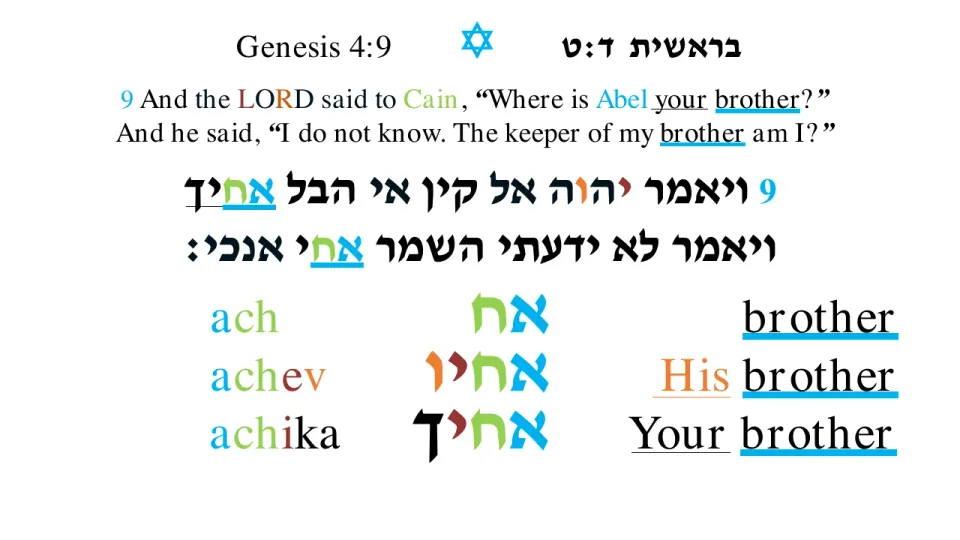 Genesis 4:9 — brother, his brother, your brother (achika, אחיך)Slide 88
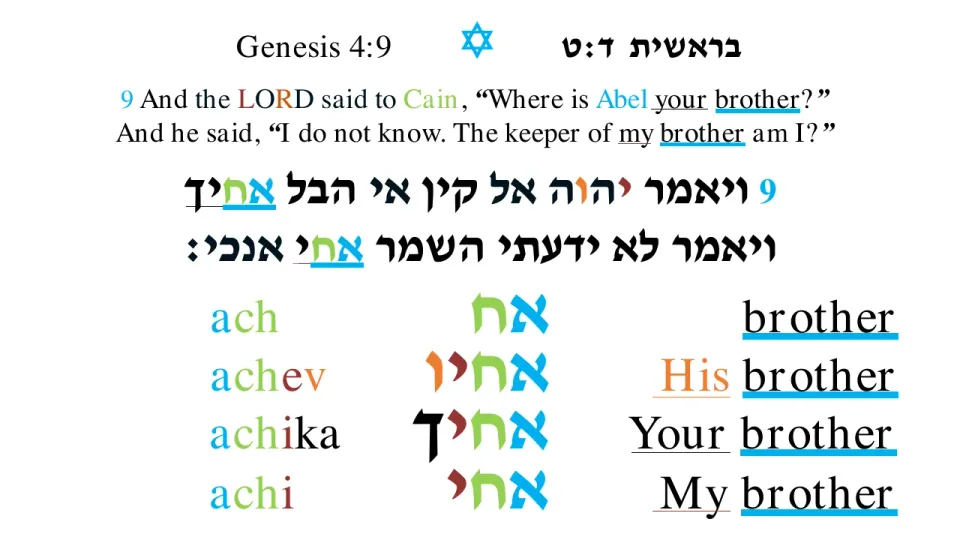 Genesis 4:9 — brother, his, your, my brother (achi, אחי)Slide 89
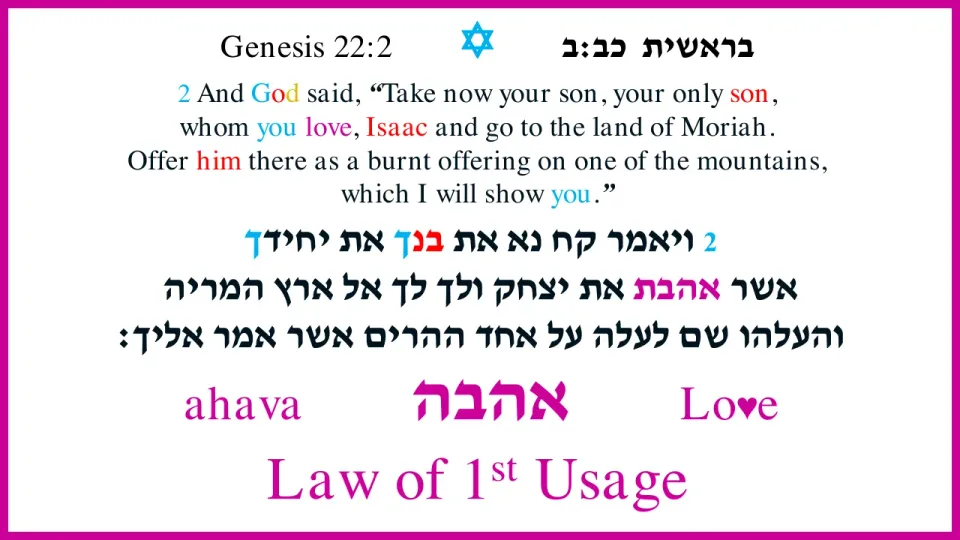 Genesis 22:2 — first use of “love” (ahava, אהבה): the Law of First UsageSlide 95
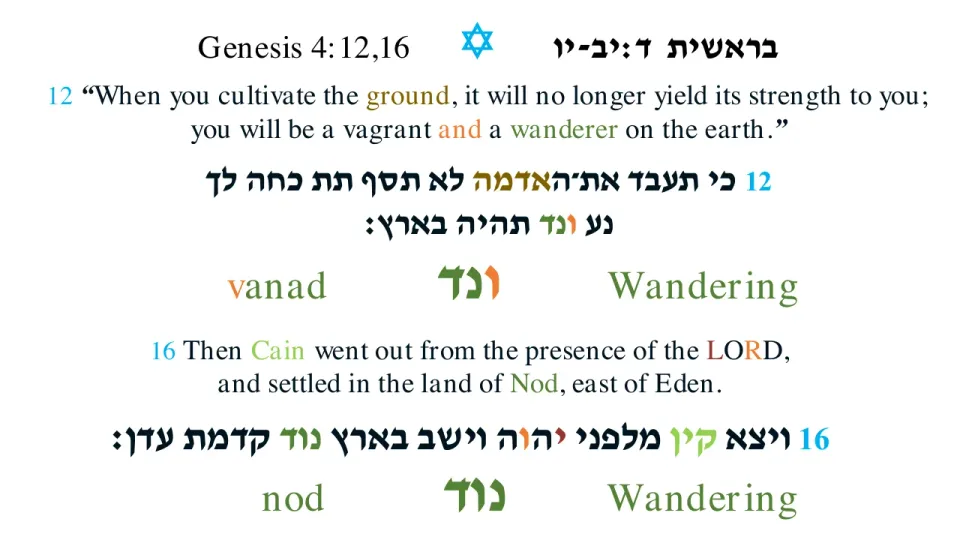 Genesis 4:12 and 4:16 — wandering: vanad (ונד) and the land of Nod (נוד)Slide 110
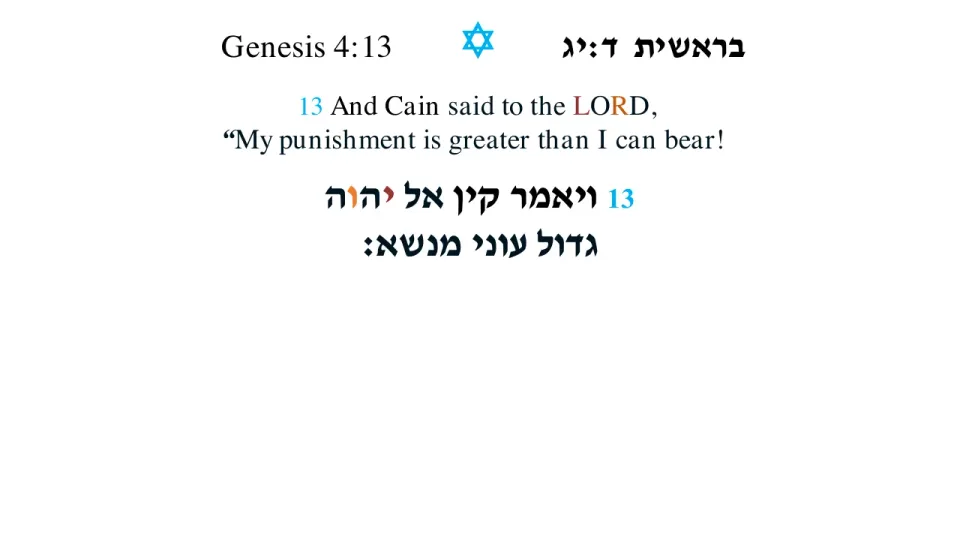 Genesis 4:13 — “My punishment is greater than I can bear”Slide 111
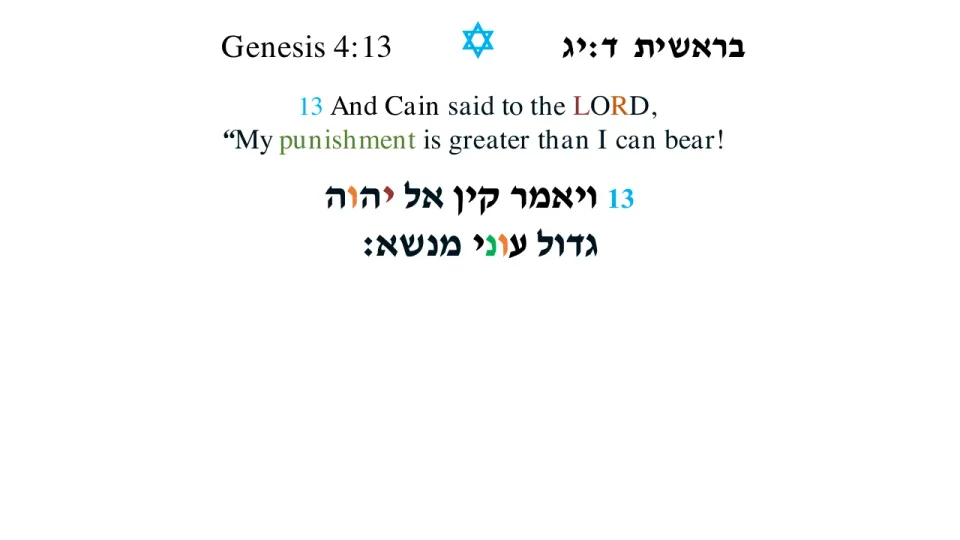 Genesis 4:13 — “punishment” highlighted (עוני)Slide 112
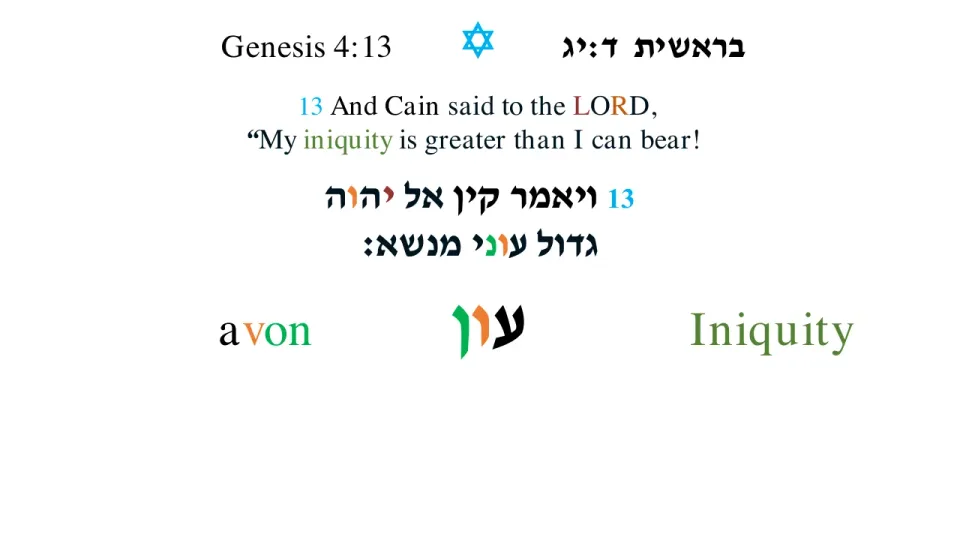 Genesis 4:13 — “iniquity” (avon, עון) instead of “punishment”Slide 113
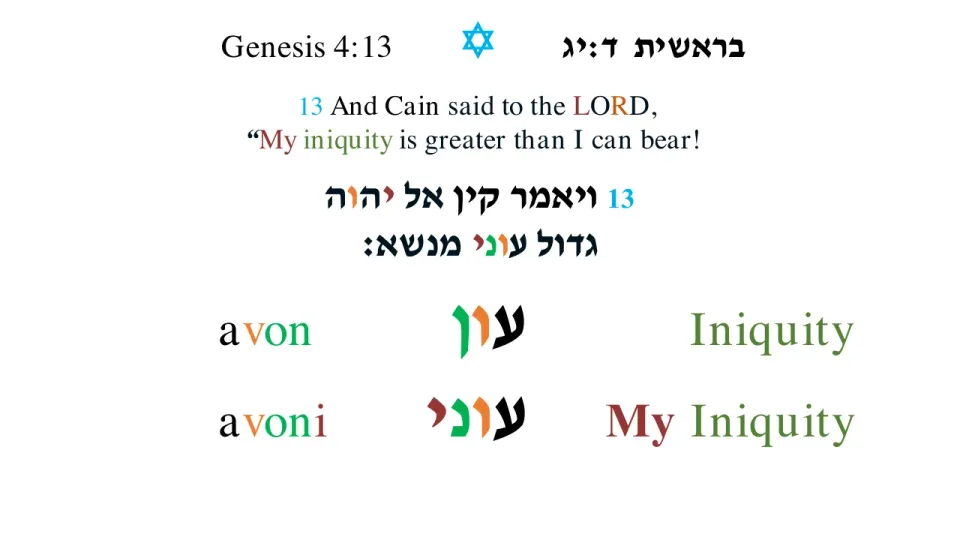 Genesis 4:13 — “My iniquity” (avoni, עוני): the yod means “my”Slide 114
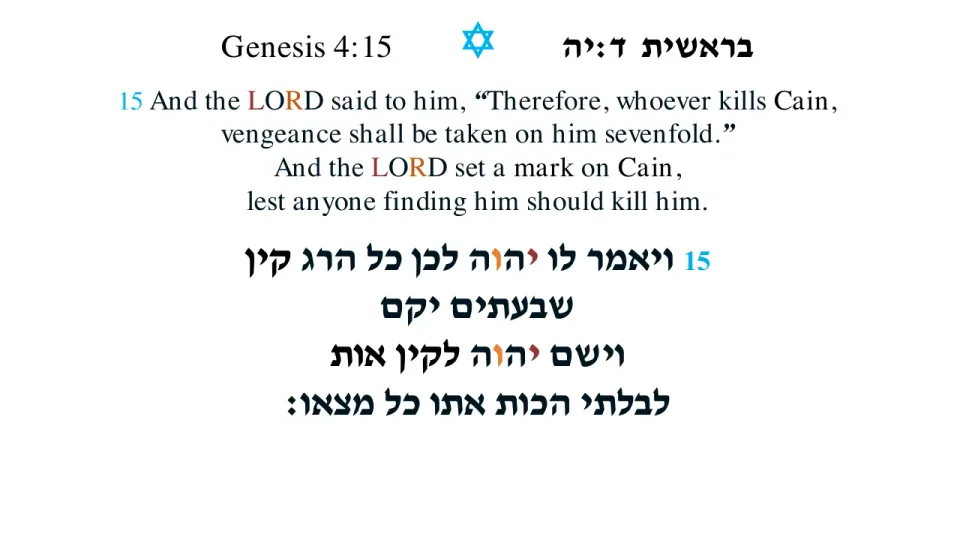 Genesis 4:15 — the LORD sets a mark on Cain; vengeance sevenfoldSlide 121
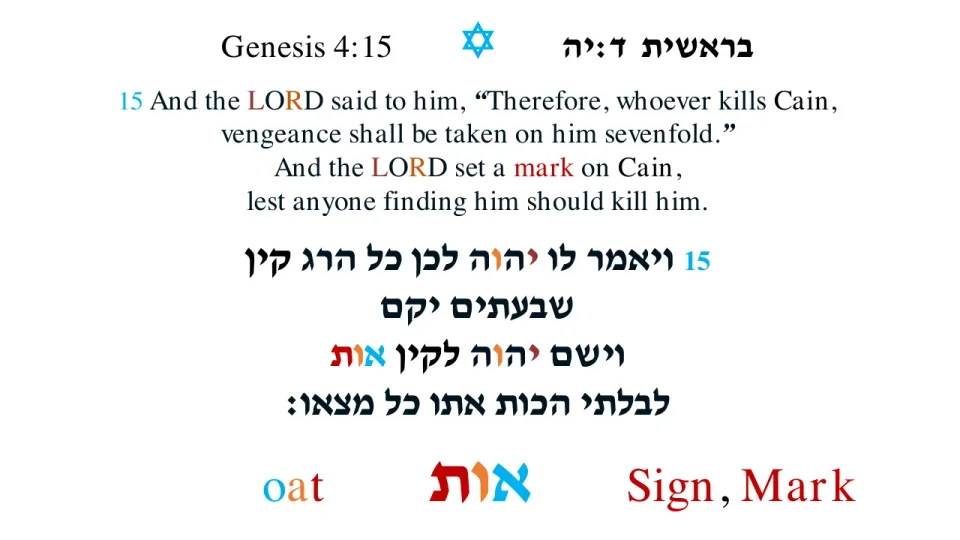 Genesis 4:15 — “mark” or “sign” (oat, אות)Slide 122
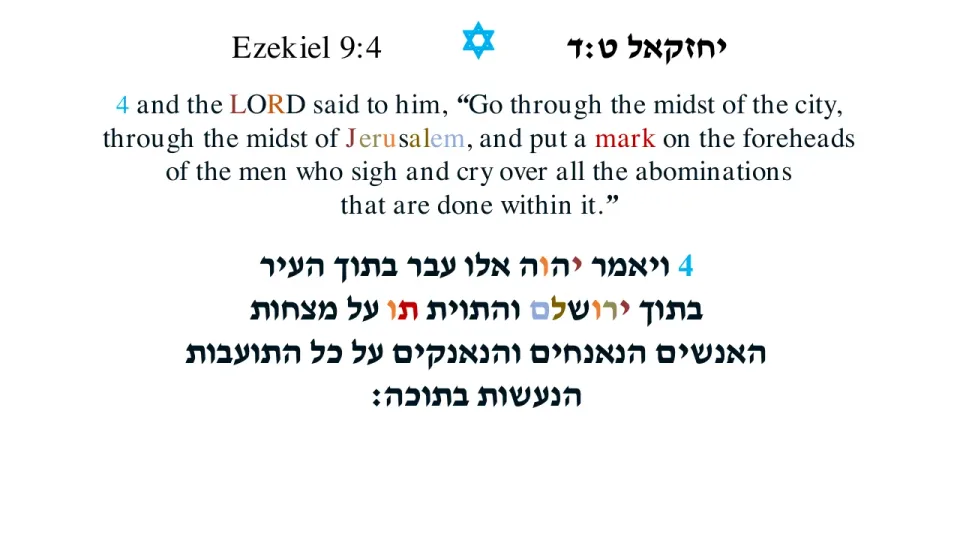 Ezekiel 9:4 — put a mark on the foreheadsSlide 126
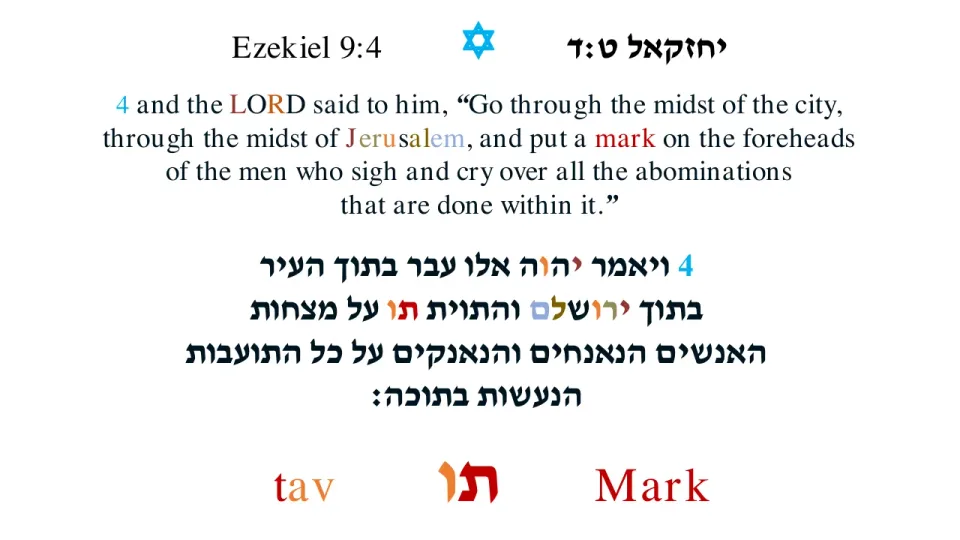 Ezekiel 9:4 — tav (תו) means MarkSlide 127
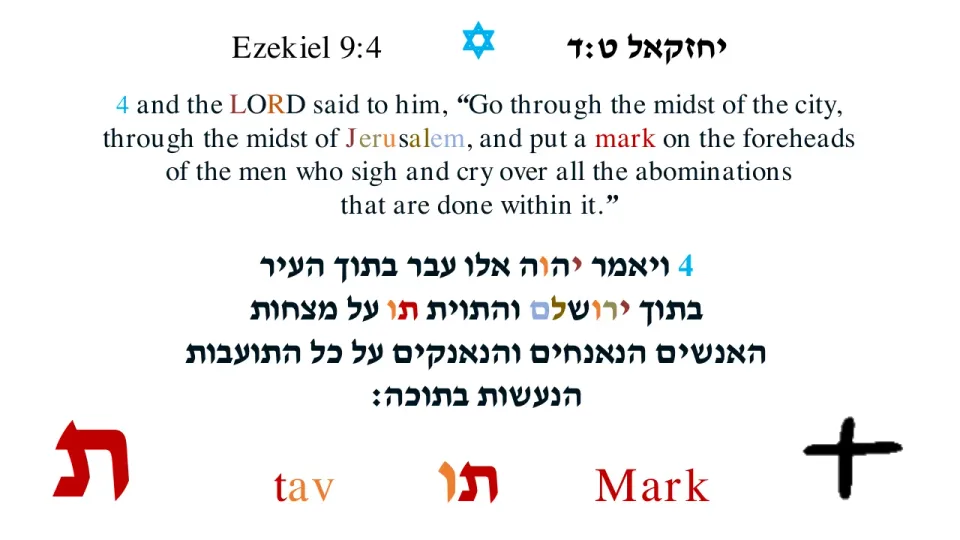 Ezekiel 9:4 — tav (תו) Mark, with the letter tav and a crossSlide 128
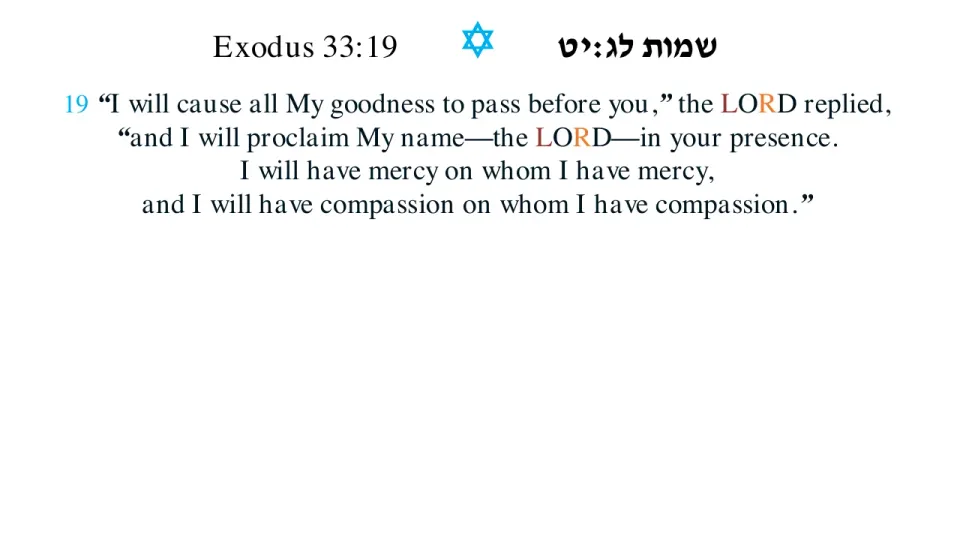 Exodus 33:19 — I will proclaim My name, the LORDSlide 129
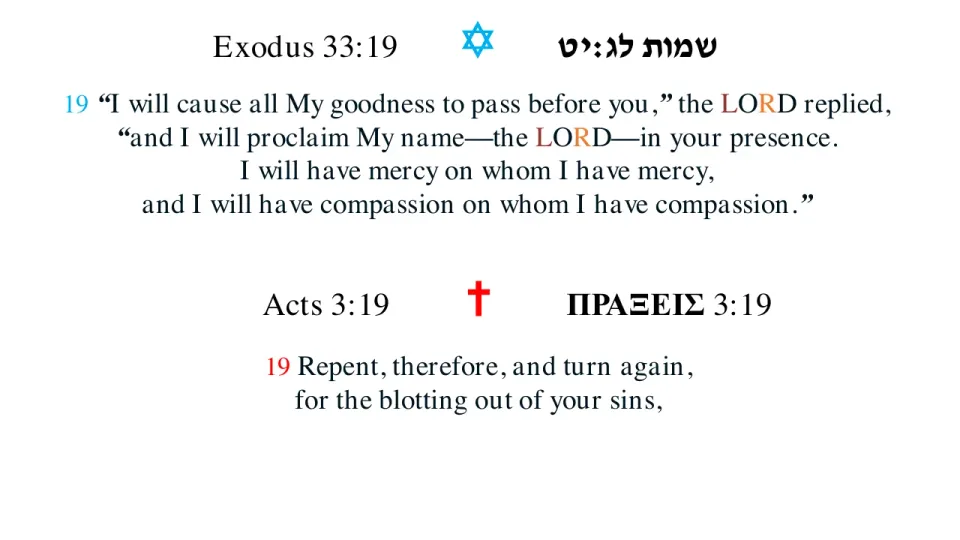 Exodus 33:19 and Acts 3:19 — mercy and repentanceSlide 130
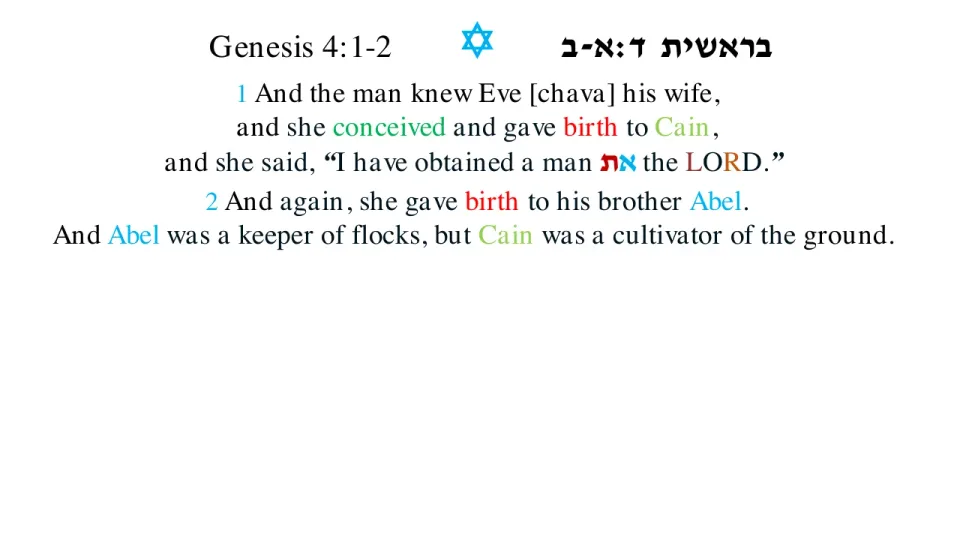 Genesis 4:1-2 — Eve, Cain and Abel, with et (את) before the LORDSlide 133
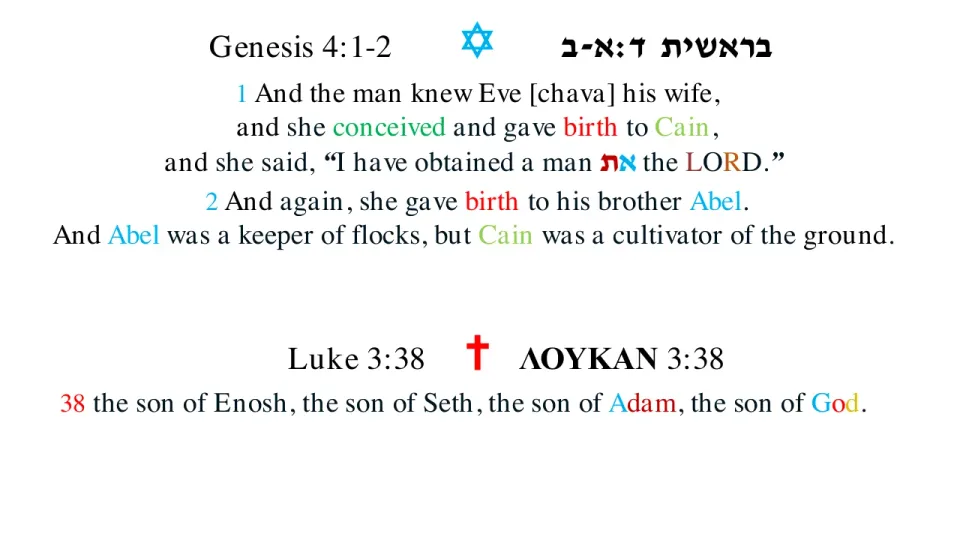 Genesis 4:1-2 compared with Luke 3:38 — Adam, the son of GodSlide 134
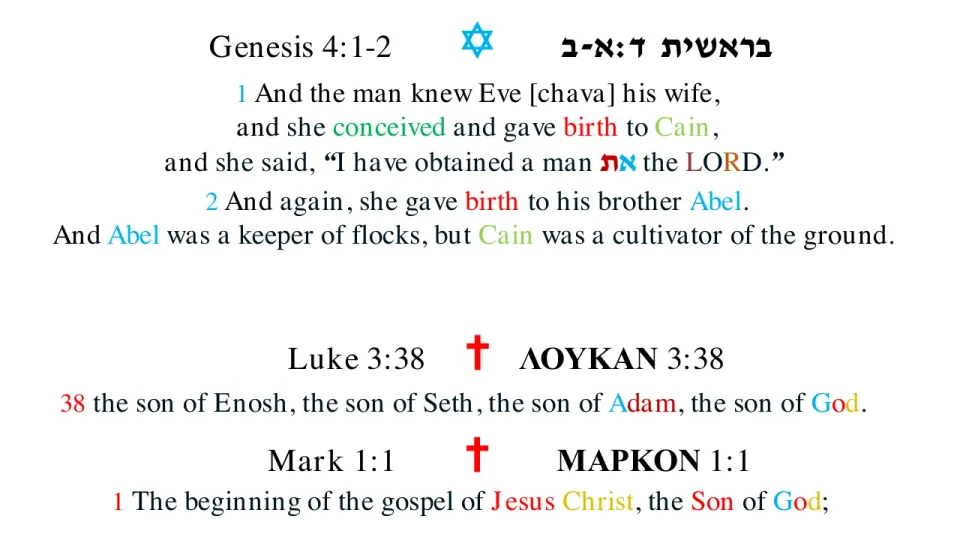 Genesis 4:1-2 compared with Luke 3:38 and Mark 1:1 — sons of GodSlide 135
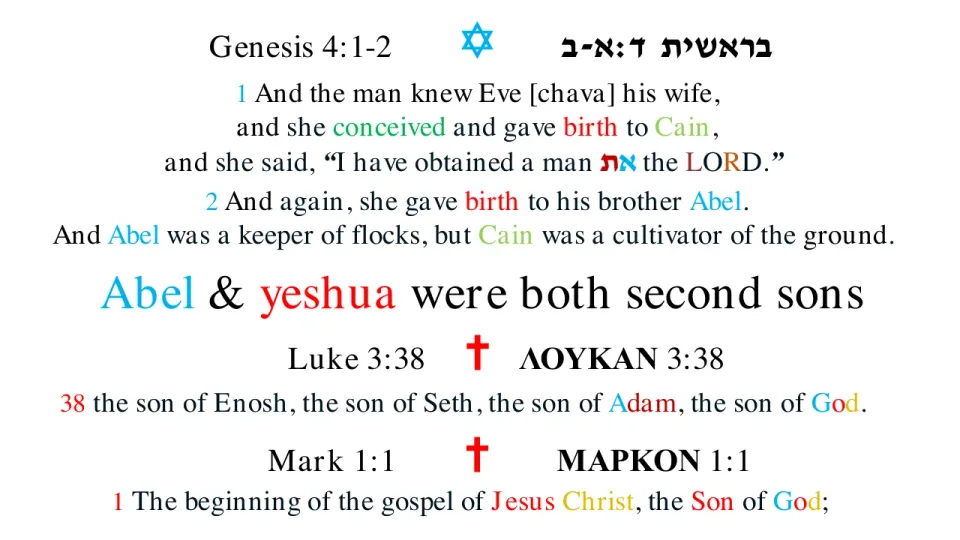 Abel and Yeshua were both second sonsSlide 136
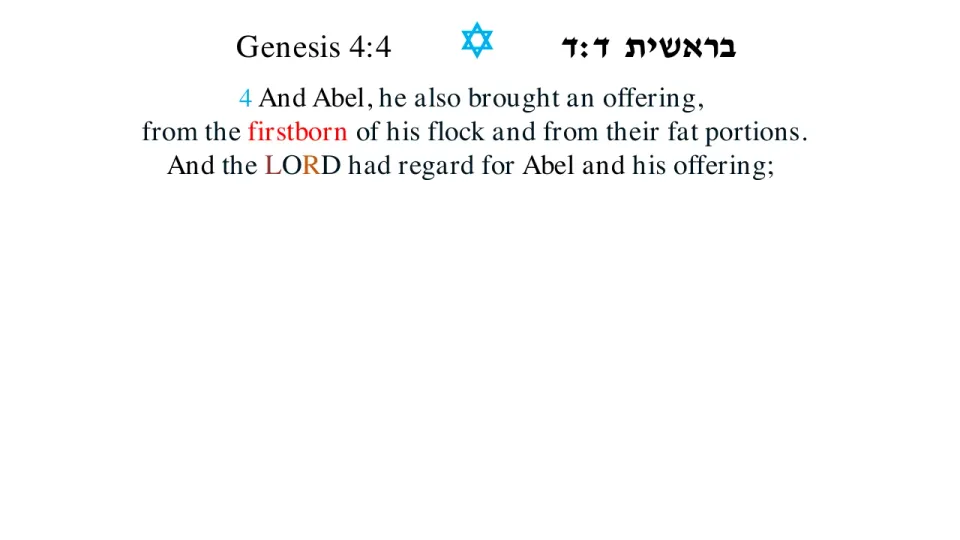 Genesis 4:4 — Abel brings the firstborn of his flockSlide 140
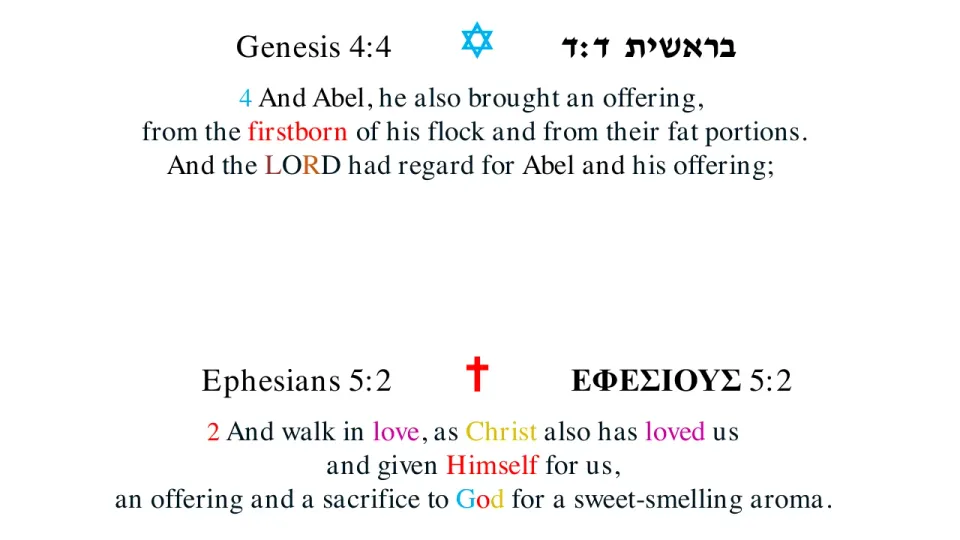 Abel's offering and Christ's offering (Genesis 4:4; Ephesians 5:2)Slide 141
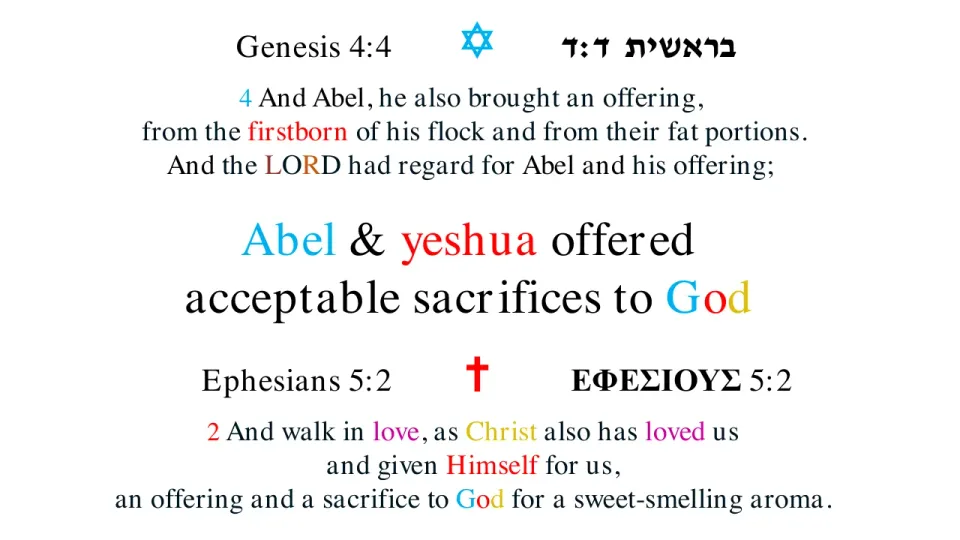 Abel and Yeshua offered acceptable sacrifices to GodSlide 142
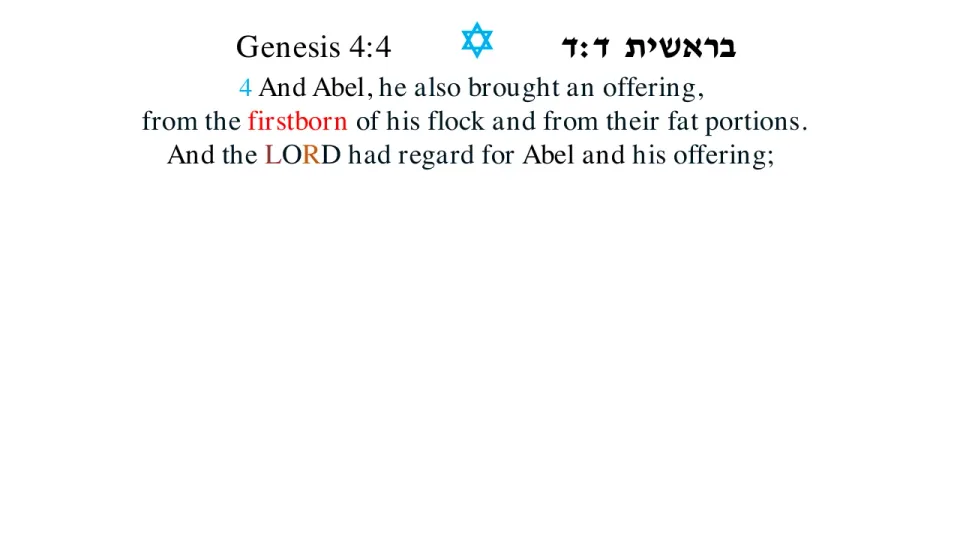 Genesis 4:4 — Abel brings the firstborn of his flockSlide 143
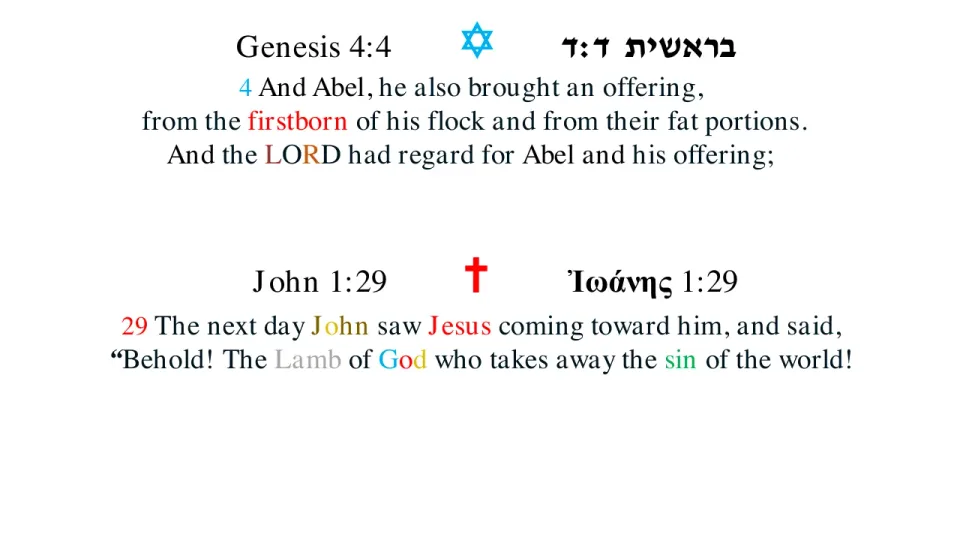 Abel's firstborn offering and the Lamb of God (Genesis 4:4; John 1:29)Slide 144
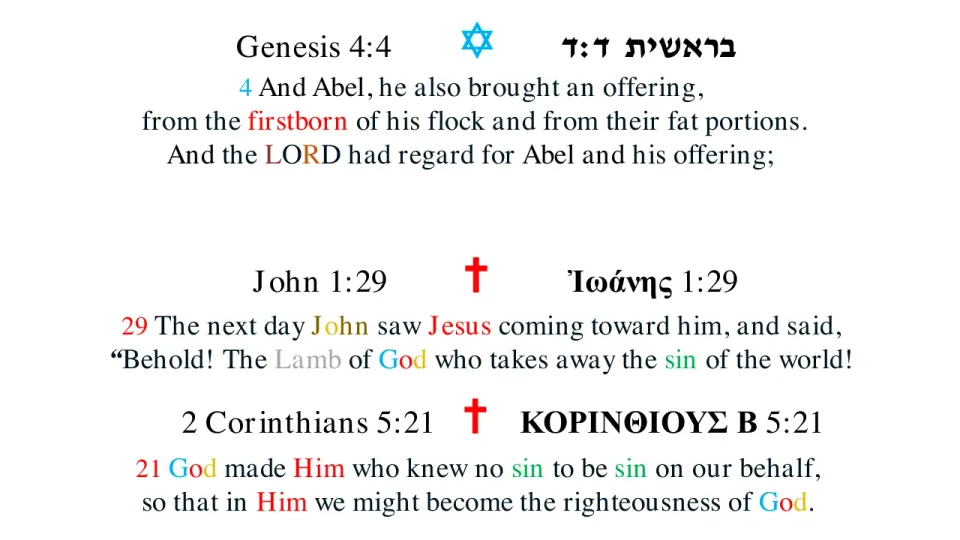 Abel's offering, the Lamb of God, and the sinless one made sinSlide 145
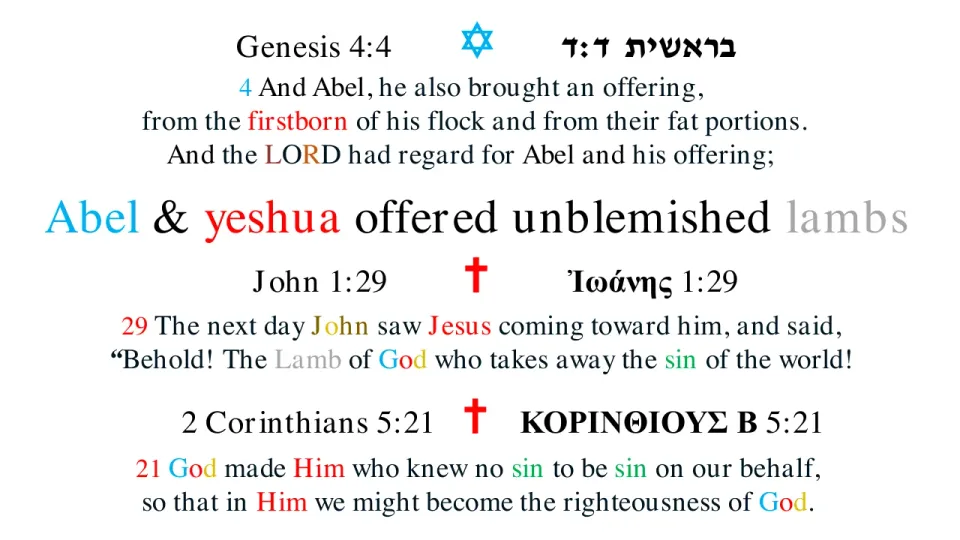 Abel and Yeshua offered unblemished lambsSlide 146
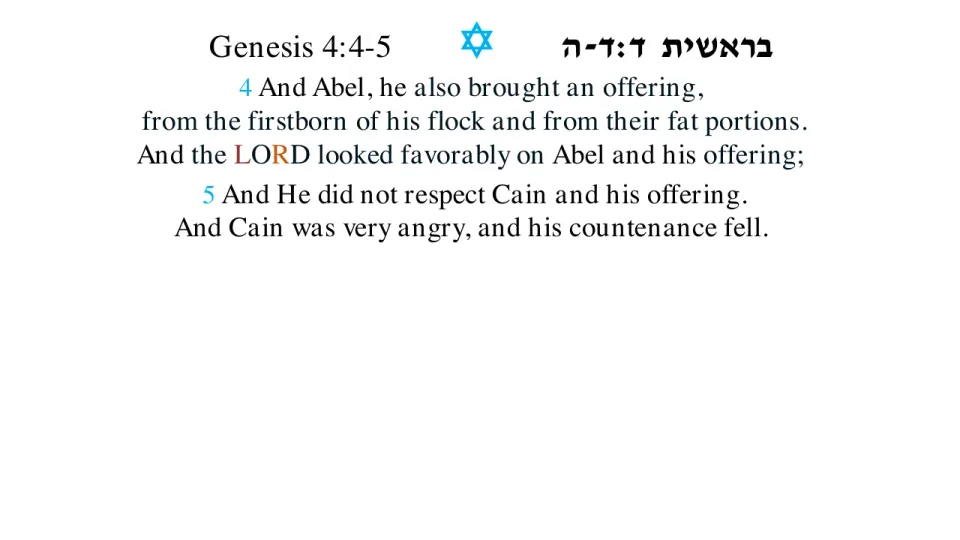 Genesis 4:4-5 — the LORD favours Abel's offering, not Cain'sSlide 147
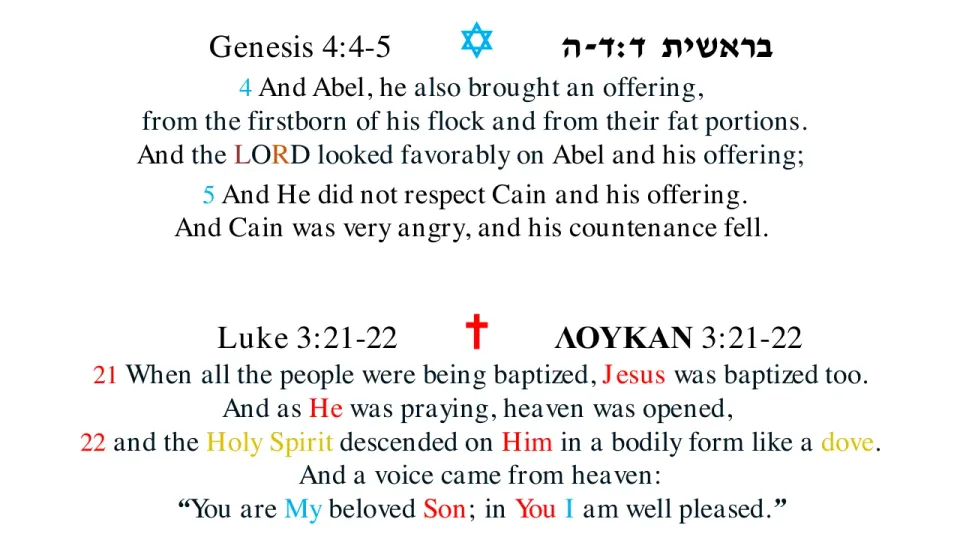 God accepts Abel's offering and is well pleased with Jesus at His baptismSlide 148
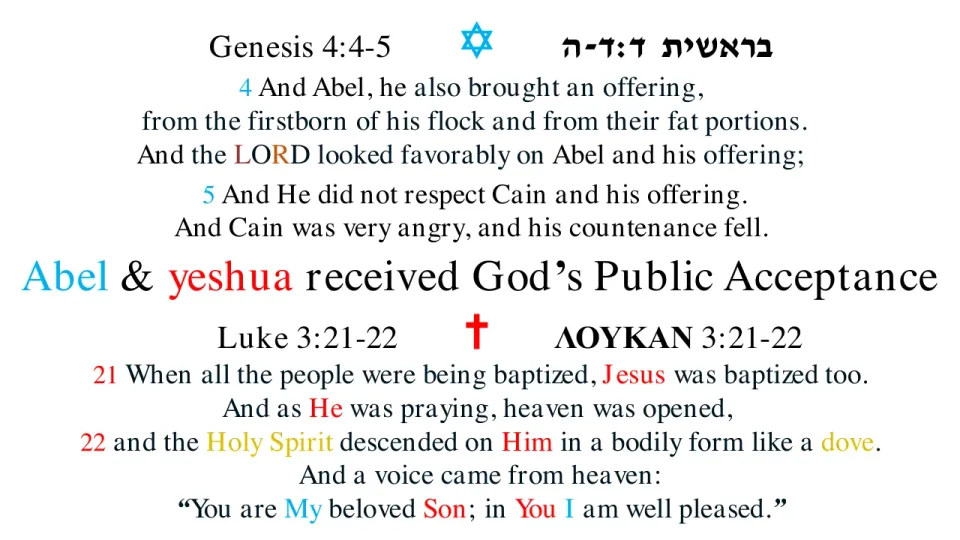 Abel and Yeshua received God's public acceptanceSlide 149
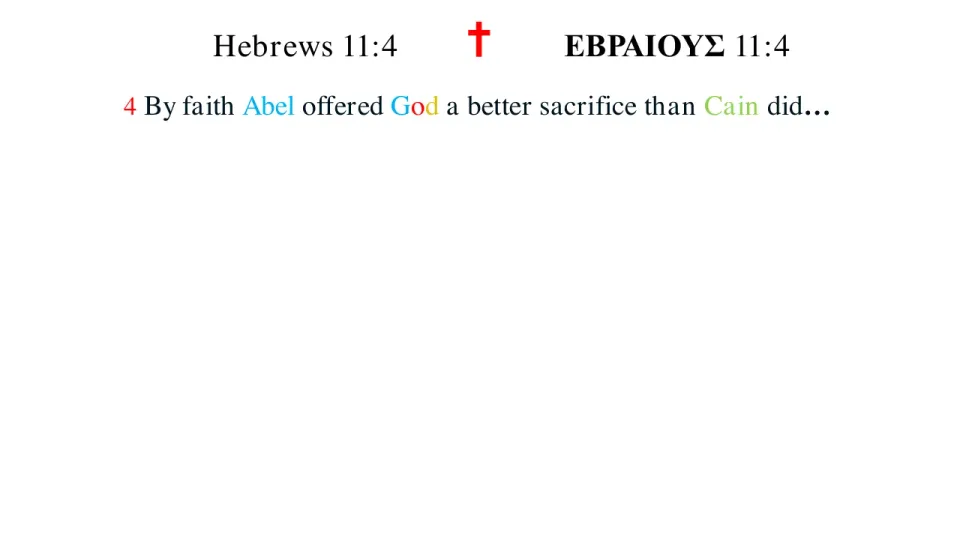 Hebrews 11:4 — By faith Abel offered God a better sacrifice than CainSlide 171
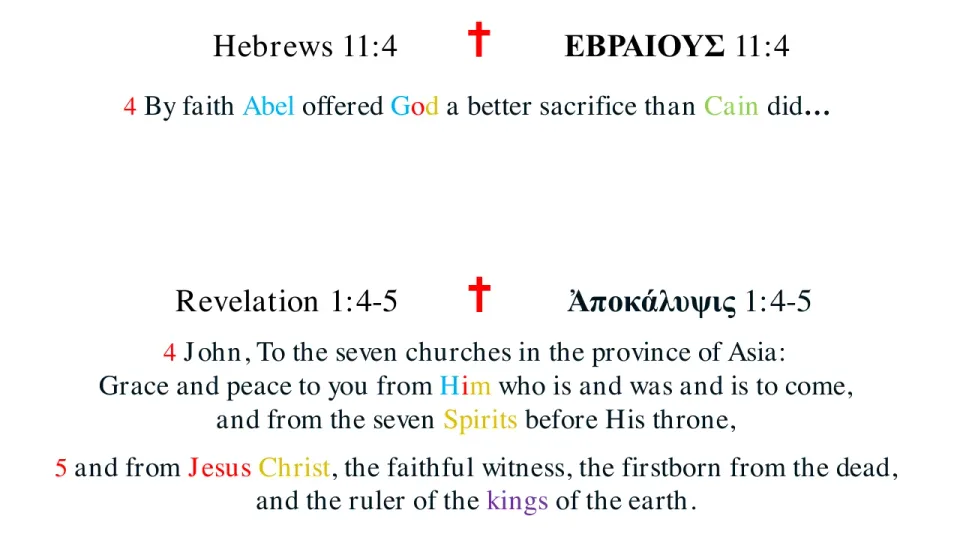 Hebrews 11:4 and Revelation 1:4-5 — Abel's faith; Jesus the faithful witnessSlide 172
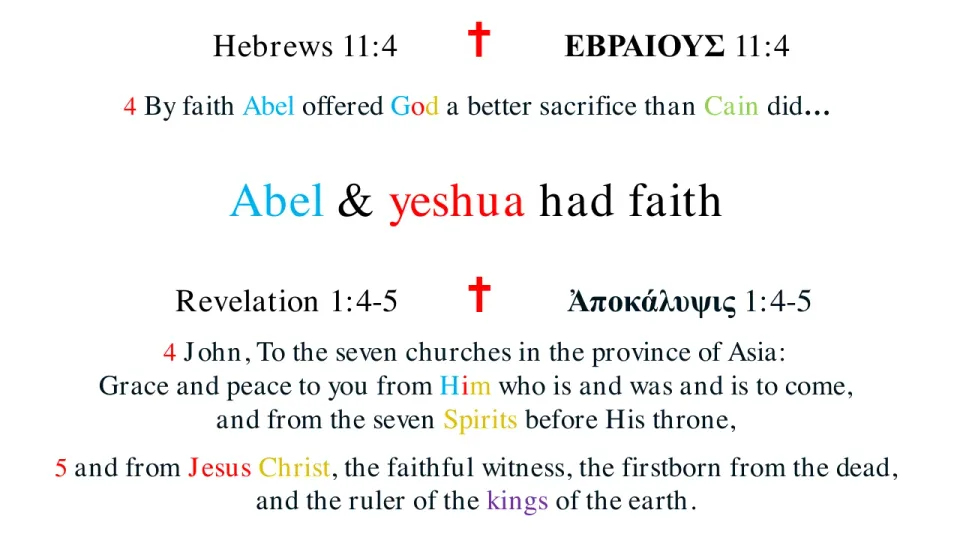 Abel and Yeshua had faith (Hebrews 11:4, Revelation 1:4-5)Slide 173
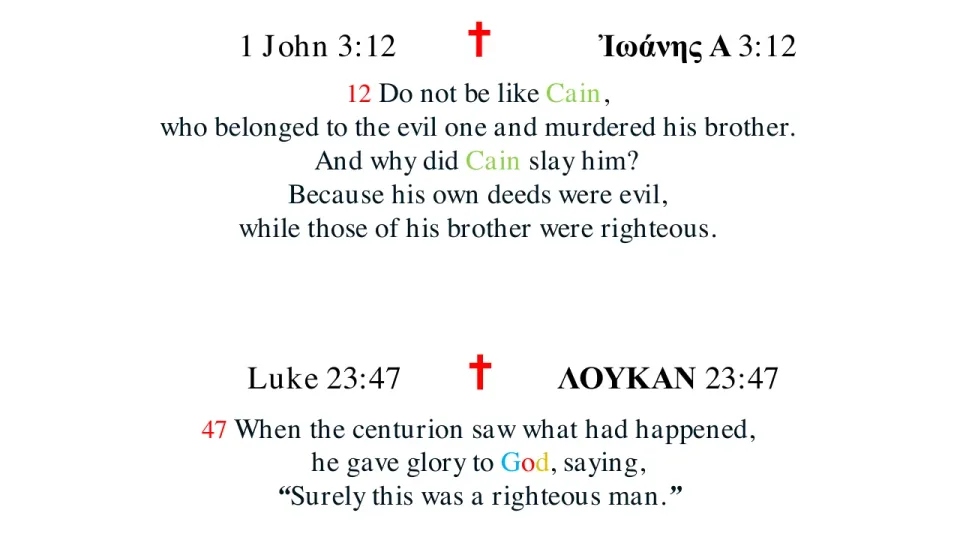 1 John 3:12 and Luke 23:47 — Cain's evil deeds, a righteous manSlide 175
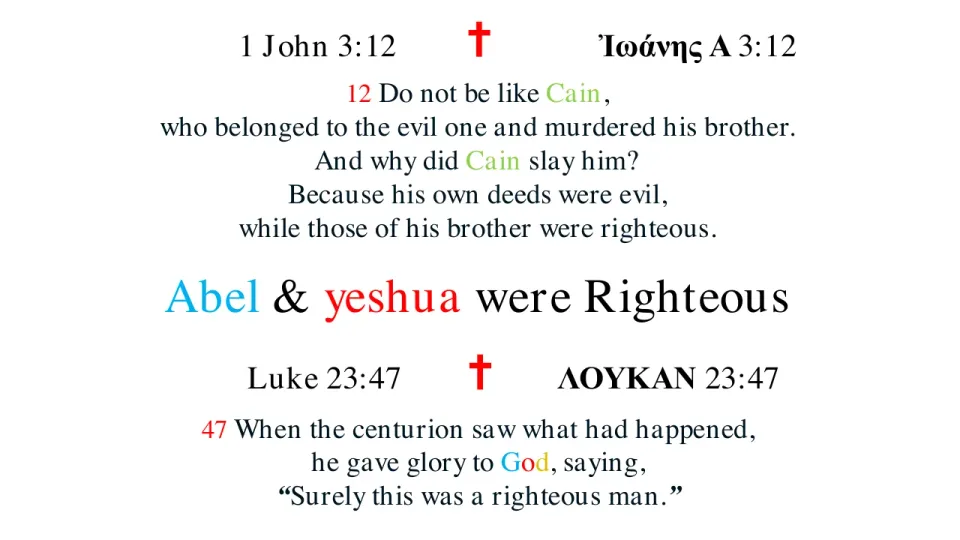 Abel and Yeshua were righteous (1 John 3:12, Luke 23:47)Slide 176
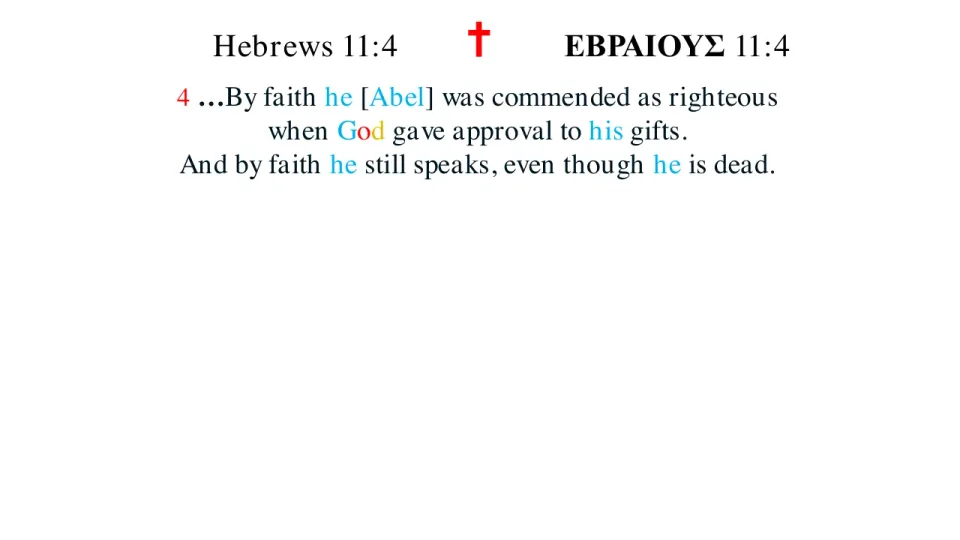 Hebrews 11:4 — Abel commended as righteous, he still speaksSlide 177
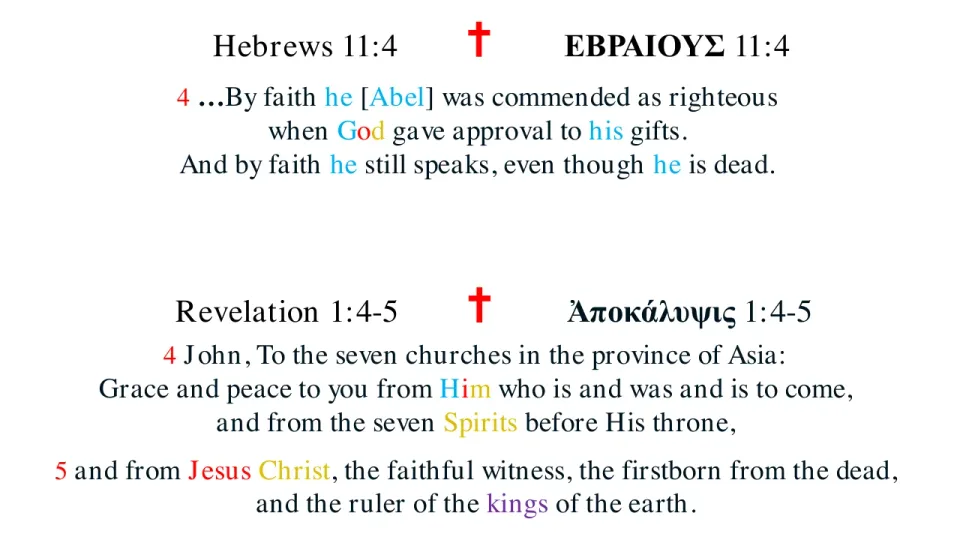 Hebrews 11:4 and Revelation 1:4-5 — Abel commended; Jesus the faithful witnessSlide 178
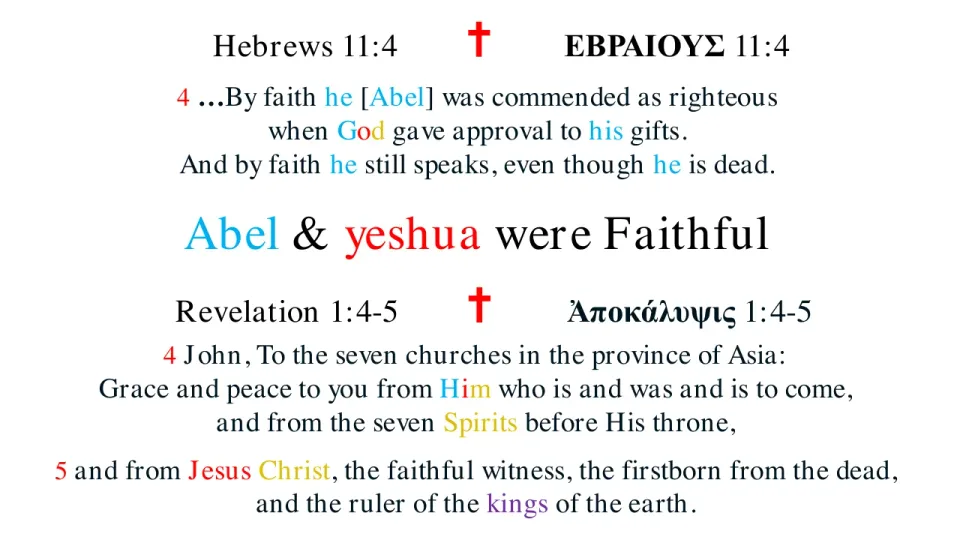 Abel and Yeshua were faithful (Hebrews 11:4, Revelation 1:4-5)Slide 179